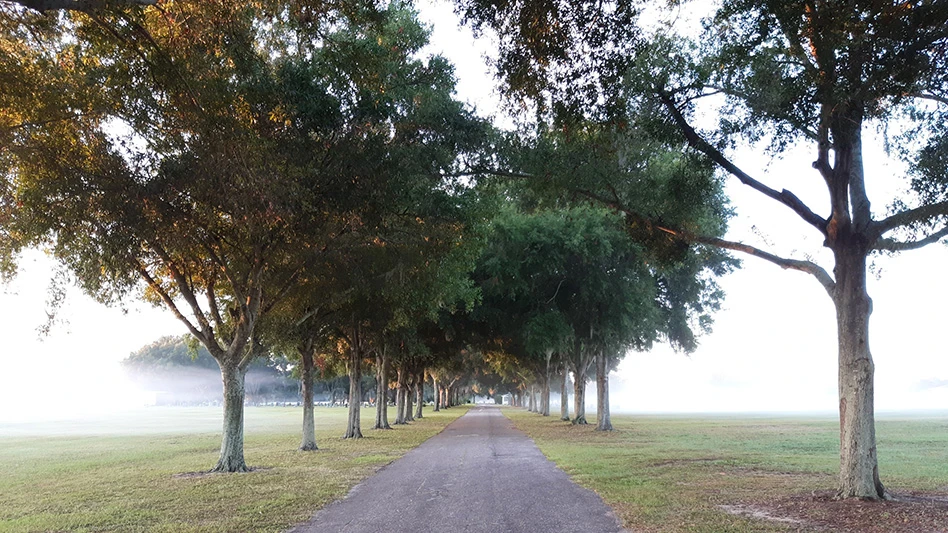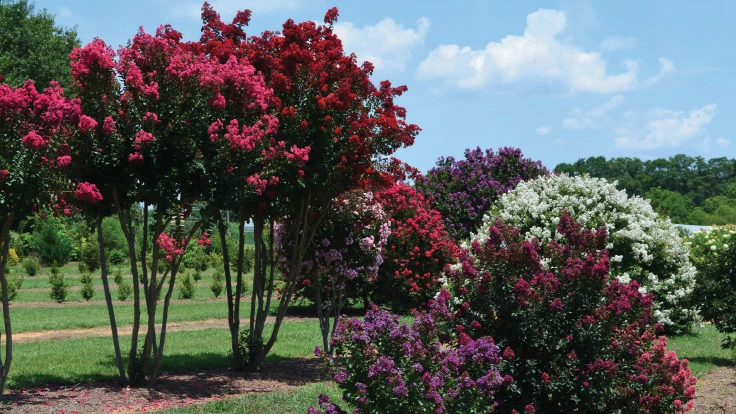
Lagerstroemia spp. is an essential flowering shrub and small tree in Zones 6-9, but the genus is now becoming common farther North. I observed healthy flowering plants in St. Louis; Cincinnati; Philadelphia; Columbia, Mo.; Greenwich, Conn.; and on Long Island.
Plants have flowers on new growth from May (depending on the location) or June into September, and if spent flowers are removed, a new flush develops in four to six weeks. In the Dirr garden, three floral flushes occurred on the earlier-flowering crape myrtles like ‘Cotton Candy’ now Pink Pig. The flower buds are beautiful, rounded in outline, often glistening red to purple. Richly pigmented bark – cream, tan, to rusty cinnamon – sheathing and exfoliating, contributes to year-long aesthetics. Full sun maximizes flowering. Once established, crape myrtles are forever. I experience magnificent specimens in old gardens and derelict homesteads. Powdery mildew and Cercospora leaf spot are the major diseases with a few insects (aphids, flea beetles, granulate ambrosia beetle) occasionally surfacing. There is also a new scale insect that has been identified in Louisiana and Texas.
Egolf’s work inspires
The great Dr. Donald Egolf’s (USNA) breeding resulted in 25 introductions, including the Indian Tribe series with ‘Chickasaw’ and ‘Pocomoke’ as true genetic dwarfs. Dr. Carl Whitcomb, of Stillwater, Okla., bred Dynamite (true red) and Red Rocket (true red), which grow 10-20 feet high. Rhapsody in Pink is sterile (almost) and Carl’s Double Feature is sterile with continuous red flowers and a 5½-by-5½-foot frame after eight years in my garden. This year brings Double Dynamite, a sterile, continual blooming, red-flowered shrub in the Play It Again series. The cherry-red flowers continued for 100 or more days in Oklahoma. It’s more heavily branched than Dynamite with wine-colored new growth which darkens with age. This disease resistant cultivar grows 8-10 feet high. The Filligree series (coral, red and violet) from Fleming’s Flower Fields, were touted as cold hardy to -30°F, but I found that was not the case. I got so-so results when I tested the series in Athens, Ga. Flower colors were not particularly rich, and all were terribly susceptible to Cercospora leaf spot, particularly ‘Red Filli.’ Described as 12-18 inches high and wide, but without dieback I estimate 2-3 feet high and wide. All appear to be derived from L. indica.
Advance in foliage color
The Early Bird series (lavender, white and purple) are touted as May flowering (May 15, at Hammond, La., trials) and continuous for three to four months. The series grows 5-8 feet by 3-4 feet. The jury is still out, as they appear to be straight L. indica derivatives. Plant Introductions planted the white (‘JD900’), lavender (‘JD818’), and purple (‘JD827’) in-ground in 2011. They did contract Cercospora, but to date I have not seen any mildew in our Georgia trials. Early Bird Lavender was the earliest to flower in LSU’s Hammond Research Station. It has been the best performer at Plant Introductions. They were bred by John Davy at Panhandle Growers in Florida, and available through Southern Living Plant Collection.

Delta Jazz (‘Chocolate Mocha’) – also available through Southern Living Plant Collection – is a major advancement in foliage color, deep chocolate-purple-maroon and fading slightly by late summer, but still potent. Flowers are bubblegum pink, but lightly, sparsely produced. Foliage (cupped leaves appear herbicide affected) displays high disease resistance. It averaged 6-7 feet by 3-3½ feet in 3 years. Distinctly upright in outline. It will reach 10 feet or greater with maturity. PII and other breeders are utilizing the genes to develop deep purple foliage colors and a spectrum of flower colors. In 2012/13, PII introduced Midnight Magic, with salmon-pink flowers and purple-black, disease-resistant foliage (4-6 or 8 feet high) and Moonlight Magic, with white flowers and purple-black, Cercospora-resistant foliage (8-12 feet by 4-6 feet). The latter will contract slight mildew. Both hold the purple-black foliage color into fall. Midnight Magic is first to flower. Moonlight Magic suffered slight stem dieback in the cold 2014 winter when temperatures reached 4°F in the Athens, Ga., area. For 2014-2015, PII added Twilight Magic to the list of purple-black foliage introductions. The habit is upright, estimating 16 feet high by 8 feet wide at maturity. Flowers are a deep pink, not unlike Delta Jazz, but produced in greater quantities. Foliage is not cupped like Delta Jazz and is highly resistant to mildew and Cercospora. This has been the most cold-hardy of the initial three purple-black introductions. A 2016 introduction, Sunset Magic, is a true cherry-red flower with shiny, dark purple-black foliage (5-10 feet high). Flowers form in prodigious quantities, virtually shrouding the foliage. It is highly mildew and Cercospora resistant. Probably best in Zone 8 and higher.
Southern Living/PDSI introduced new purple foliage cultivars in 2013/2014: Delta Eclipse (lavender-purple) 6-10 feet high by 4-5 feet wide; Delta Moonlight (white), 4-6 feet high and wide; Delta Flame (dark red), 6-10 feet high by 4-5 feet wide; Delta Breeze (pink-lavender), 6-10 feet high by 4-5 feet wide and Delta Fusion (fuchsia), 6-10 feet high, new for 2016. These are from a different breeder (Buddy Lee) than Cecil Pounders’ Black Diamond and Ebony series.
For much more from Dr. Dirr, read the full article in our August issue.
Latest from Nursery Management
- Jackson & Perkins expands into Canadian market
- Green & Growin’ 26 brings together North Carolina’s green industry for education, connection and growth
- Marion Ag Service announces return of Doug Grott as chief operating officer
- The Garden Conservancy hosting Open Days 2026
- Registration open for 2026 Perennial Plant Association National Symposium
- Artificial intelligence applications and challenges
- Fred C. Gloeckner Foundation Research Fund calls for 2026 research proposals
- Harrell’s expands horticulture team with addition of Chad Keel