PHOTOS: MARK DWYER
Editor's Note: This article originally appeared in the May 2025 print edition of Nursery Management under the headline “Sambucus racemosa Lemony Lace.”
I have a penchant for golden foliage. I appreciate the illumination, glow and focus that yellow/gold foliage plants provide when used in the landscape as primary features or accents. For over 30 years, I’ve grown a wide range of golden-foliage, red elderberries (Sambucus racemosa) with ‘Sutherland Gold’ being one of my “go to” golden shrubs for quick growth and textural impact. I like elderberries for a wide range of reasons, but I didn’t think the older golden selections (‘Morden Golden Glow’ being another nice one) could be improved upon in any way. That was until the award-winning, Lemony Lace was introduced about 10 years ago.

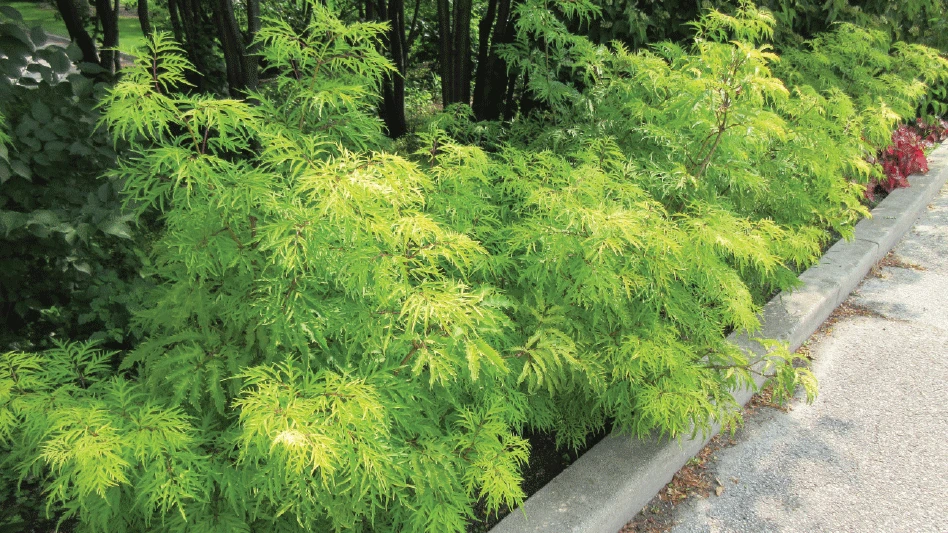
Compared to other selections, Lemony Lace seems to have even finer, dissected foliage that features red tinting at emergence but really brightens up to a golden yellow in full sun. Adaptable to part shade as well, this deciduous, suckering selection is freely branching and is fairly compact compared to larger selections at 7 feet tall and wide in time. While somewhat sprawling and irregular, the textural contribution, coupled with the bright chartreuse (part shade) to golden foliage makes this bright, “feathery mound” a masterpiece as a focal point, informal hedge or repeated woody element.
Early spring, white flower clusters later form red fruits (drupes) in later summer that will be of interest to birds. However, I’ve rarely observed flowers as this shrub blooms on old wood and I usually do a little spring pruning to encourage vigorous, new growth. The bright coloration of Lemony Lace is maintained in the summer heat of northern climates, particularly in moist, well-drained situations. While full sun is ideal for maximum coloration, in warmer zones, a bit of shade is warranted. This species is soil adaptable but again, ample moisture is ideal.
Lemony Lace is deer resistant although it does have some susceptibility to canker, mildew, borers, leaf spot and other challenges. Similar to the older varieties mentioned above, which can get quite large over time, a severe cutback on this shrub in later winter (to 12 inches or so) will result in amazing regrowth and vivid coloration (albeit at the expense of flowers/fruits). This rejuvenation, while not required, is a good way to maintain a smaller size and encourage vigorous, lush new growth.


Explore the May 2025 Issue
Check out more from this issue and find your next story to read.