Photo courtesy of GDA
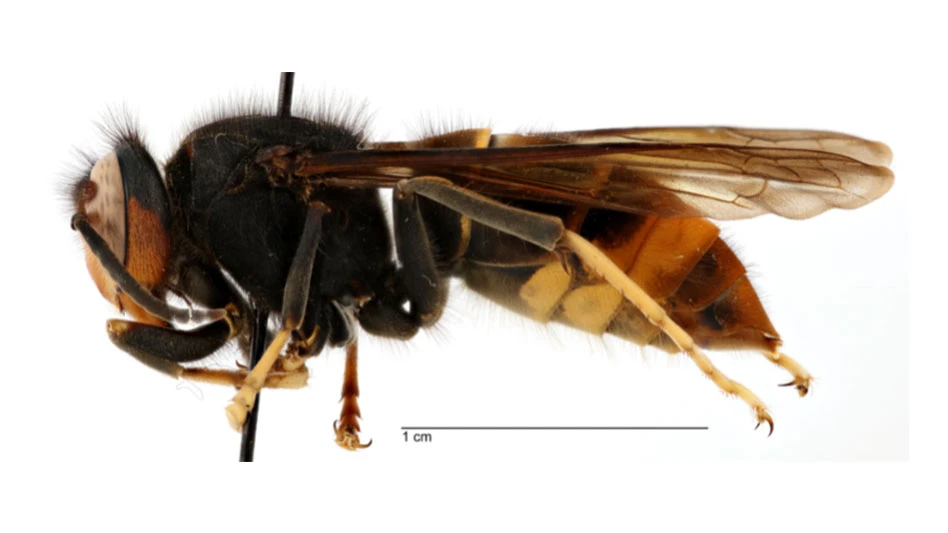
The Georgia Department of Agriculture (GDA) announced, in coordination with USDA and the University of Georgia, confirmation of the detection of a living yellow-legged hornet in Georgia for the first time. This is the first detection of a live yellow-legged hornet in the open United States. GDA is asking the public to report any sightings of the yellow-legged hornet, a non-native hornet species, that, if allowed to establish in Georgia, could potentially threaten honey production, native pollinators, and the state’s number one industry - agriculture.
Earlier in August, a beekeeper in Savannah, GA, found an unusual hornet on his property and reported it to the GDA. On Aug. 9, 2023, the U.S. Department of Agriculture’s Animal and Plant Health Inspection Service (APHIS) confirmed the University of Georgia’s (UGA) identification of this insect as a yellow-legged hornet (YLH; Vespa velutina).
"Georgians play an important role helping GDA identify unwanted, non-native pests, and I want to thank the beekeeper who reported his sighting to us, as well as our partners at the University of Georgia and USDA’s Animal & Plant Health Inspection Service for working swiftly to confirm its identity," said Agriculture Commissioner Tyler Harper. "Our experienced team of professionals will continue to assess the situation and are working directly with USDA APHIS and UGA to trap, track, and eradicate the yellow-legged Hornet in Georgia. "
The yellow-legged hornet is a social wasp species that constructs egg-shaped paper nests above ground, often in trees. These nests can become large, housing an average of 6,000 workers. The yellow-legged hornet is native to tropical and subtropical areas of Southeast Asia. It is also established in most of Europe, parts of the Middle East, and parts of Asia where it isn’t native.
“The foundation of this response is the strong relationship USDA has developed with the Georgia Department of Agriculture and the University of Georgia over many years,” said Dr. Mark Davidson, Deputy Administrator of APHIS’ Plant Protection and Quarantine Program. “Our partnership is already paying off as our teams come together to apply the science and technology in our response planning. The public can also play a critical role by reporting potential sightings of the hornet to help eradicate this pest.”
The GDA and APHIS will continue to provide public outreach and education about the hornets and encourage the public to document and report hornet sightings. However, yellow-legged hornets can be dangerous, and the GDA encourages everyone to use caution in the event of a sighting.
GDA’s website has been updated with additional information regarding the yellow-legged hornet and an easily accessible form to report potential sightings. This information is prominently displayed on the homepage of the website. Georgians with additional questions or concerns are encouraged to email the GDA at yellow.legged.hornet@agr.georgia.gov.
Here is what to include with your report, if possible:
- Your name and contact information.
- The location of the sighting.
- Date of sighting.
- If you can, safely take photograph(s) of the hornet (they generally can only confirm a report with a photo or specimen).
- Location and approximate height of the nest if found (Is it in a tree? Approximately how high is the nest?).
- If you have no photo, please include a description of the size of the insect, the color of the head and body, and what it was doing.
- Description of the hive loss/damage (if no photo is available).
- The direction the hornet(s) flew when flying away.
Please note: There are many domestic lookalikes that are native to the United States and do not pose a threat to honeybees. Many of them are valuable pollinators. USDA has a photo gallery of look-a-likes. To get to the gallery, go to www.aphis.usda.gov, and search for “yellow-legged hornet.”
If you believe you saw a yellow-legged hornet in another state or province, please report it to the Department of Agriculture for that state or province.
Latest from Nursery Management
- Jackson & Perkins expands into Canadian market
- Green & Growin’ 26 brings together North Carolina’s green industry for education, connection and growth
- Marion Ag Service announces return of Doug Grott as chief operating officer
- The Garden Conservancy hosting Open Days 2026
- Registration open for 2026 Perennial Plant Association National Symposium
- Artificial intelligence applications and challenges
- Fred C. Gloeckner Foundation Research Fund calls for 2026 research proposals
- Harrell’s expands horticulture team with addition of Chad Keel