True for all of those in his line of work, the weeks leading up to Thanksgiving were Casey Grogan’s busiest time of year. Earlier in November, he harvested 70,000 Noble and Nordmann firs at Silver Bells Tree Farm, his Christmas-tree farm in the foothills of Oregon’s Cascade Mountain Range. As the holiday neared, he watched his crop cruise off in the backs of around 100 semi-trucks, following the path of most of the Pacific Northwest’s holiday crop, 92 percent of which is shipped to outside the region. Nearly half of that lands in California, and most of the rest ends up elsewhere in the West, in Gulf states, or in Mexico.
This was a smaller season than Silver Bells has known in the past: The farm, which once shipped about 100,000 trees annually, downsized from 700 to 400 acres of Christmas trees in recent years. The reduction is part of a trend that has played out across the Pacific Northwest—the country’s leading Christmas tree–growing region, with Oregon the highest-producing state and Washington the fifth—and is the long-realized product of overzealous planting 20 years ago.
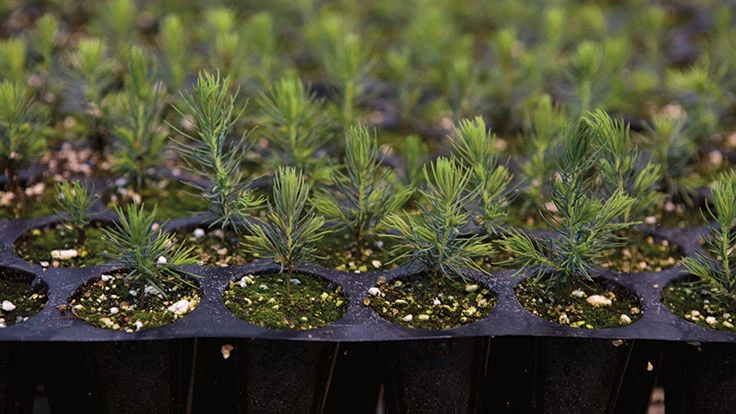
Photo: Evergreen seedlings by Jason Mann
Latest from Nursery Management
- [SNEAK PEAK] Leading Women of Horticulture: Louise Schaefer and Susan Tantsits
- The Growth Industry Episode 10: State of the Horticulture Industry
- Tennessee Green Industry Field Day scheduled for June 11
- UTIA and UT Knoxville research teams will develop automated compost monitoring system
- Ken and Deena Altman receive American Floral Endowment Ambassador Award
- [SNEAK PEEK] Leading Women of Horticulture: Becky Thomas
- [SNEAK PEEK] Leading Women of Horticulture: Angela Burke
- [SNEAK PEEK] Leading Women of Horticulture: Alexa Patti