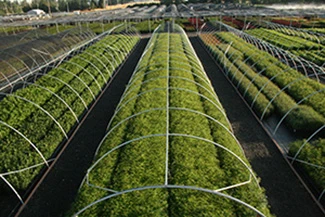
There is no value behind a low quality liner, and you can’t make money off of a dead tree. To create maximum profits on shade trees, you have to start with the best quality tree liner available. A quality liner is going to be consistent in grade, transplant successfully, and, given the proper climate, water and nutrition, it will grow vigorously. Always remember, your overhead can grow, but your profit margin can die.
Surface Nursery in Gresham, Ore., understands the value in buying in liners to increase efficiency. Surface Nursery buys Anderson Band Pot-grown seedlings, field-grown seedlings and rooted cuttings from JLPN.
"We have a large diversity of product, and that's one reason we buy in liners from JLPN," says Graham Anderson, production manager at Surface Nursery. "If we had to produce the total quantity we needed, that would be inefficient. And seedling production takes a lot of labor. Outsourcing things that are less efficient for us allows us to focus on what we do best."
Consistency in Grade
A grower who plants tree liners, either purchased or self-produced, should always insist on uniformity. Seedlings should have consistent caliper and height with good root fiber and structure. Rooted cuttings should have roots lining 85% or more of the base of the cutting, and should also be matching in caliper and height. These standards lead to better uniformity and durability of the crop. If you start with a variable grade liner, that variability will continue through the life cycle of your crop. If you start with uniformity, you will end with a uniform crop.
Purchased liners and under stock should never require a re-grade -- that only consumes labor and ultimately lowers margins. As a result of planting uniform plants, the crop is more likely to make the size needed for sale, or for budding and grafting. If you were to plant 1,000 understocks at $1 each and 35% of them died or didn’t make-up large enough to bud, your company just increased the liner cost by 50% to $1.50. The loss of the liner, coupled with the loss of labor invested in planting and prep, ultimately reduces the amount of sellable inventory and eats away at profits and revenue potential in the end. Consistency in grade pays off in multiple ways from the time you receive your tree liners.
Transplant Success/ Growth Performance
Every time you plant liners, you are starting with the maximum potential volume you will end with. For every liner planted that doesn’t survive, you just payed double for the liner next to it. Transplant survivability is a financially crucial attribute to a durable liner.
When planting quality liners, you want your plants to look happy, healthy and alive going down the row. Skips cost money and so do dead plants, so transplant survivability is paramount. This is a result from planting healthy, durable, well-rooted liners. Less skips equals more plants to sell, which equates a better return on your investment. Eliminate skips.
No doubt growing practices and environments vary from grower to grower, but growth performance is a critical element and essential value of a tree liner. A liner that is happy, healthy and consistent in grade will no doubt outgrow a liner lacking the same attributes.
"JLPN has an experienced staff and they have good procedures in place, which helps ensure high quality products," Anderson says. "We're looking for high-quality liners with straight trunks, well-developed roots, and stock that is free of disease and pests. That's our expectation from JLPN, and they're able to deliver."
Profitability
If 25% of your crop makes up one grade size, the result is pure profit, as your overhead remains the same. When a grower commits to buying from a liner producer, they are ultimately putting their faith in the liner producer to send products that are going to create higher profit margins.
If a grower is planting 1,000 plants, the more that make sellable grade in the end ultimately affects the overall strength and profitability of the crop and the company. Your crop isn’t profitable until all of your overhead is paid and covered. If you needed 70% of your crop to be sellable to cover your overhead, and 80% made it, you’ve profited. However, if 90% of your crop reaches sellable size, you just doubled your profit margin at no additional cost.
Questions a grower should never have: “What’s my order going to look like? What’s the grade going to be? Do I need to order extras because they are a mixed bag of grades? Will I have to re-grade? Will they survive transplant?” If these are questions you're asking, you need a different supplier!
In most cases, the old adage of you get what you pay for also rings true in the value of a liner. If you start with quality, you drastically increase your chances of ending with quality. You also will end with more plants to sell, as well as creating more profits.
John Holmlund Nursery in Boring, Ore., used to do much of its own propagation. But the nursery decided to "tighten up" and focus on other parts of production and sales, says Mike Reihs, production manager at John Holmlund Nursery.
"We turned over a large amount of propagation to JLPN. "It frees up labor and takes the burden off of us to grow that starter plant," he says. "The foundation of what we sell starts with a healthy root system, and JLPN does an outstanding job with that. The quality is always top notch. Because of their growing and grading process, we consistently get a good, strong, high-quality plant."
For more information on JLPN Liners, click here.
Latest from Nursery Management
- Jackson & Perkins expands into Canadian market
- Green & Growin’ 26 brings together North Carolina’s green industry for education, connection and growth
- Marion Ag Service announces return of Doug Grott as chief operating officer
- The Garden Conservancy hosting Open Days 2026
- Registration open for 2026 Perennial Plant Association National Symposium
- Artificial intelligence applications and challenges
- Fred C. Gloeckner Foundation Research Fund calls for 2026 research proposals
- Harrell’s expands horticulture team with addition of Chad Keel