Photo courtesy of UF/IAS.
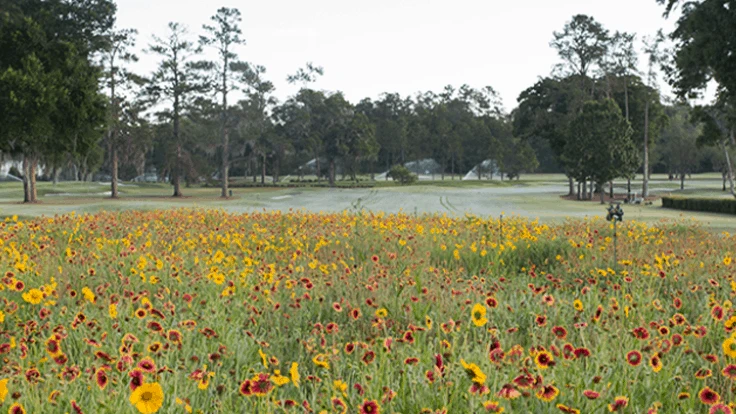
A new study from the University of Florida/IFAS shows that planting wildflowers on golf courses not only benefits pollinating insects but also saves time and resources.
“Putting wildflowers on golf courses to help pollinators isn’t a new idea. What is new is demonstrating the direct benefits of flowering plants to golf course managers, in the form of pest management,” said Adam Dale, assistant professor of entomology and the study’s lead author.
This is because wildflowers attract insects that attack common golf course pests, plus wildflowers don’t need the fertilizer, water and mowing that the rest of the course does, Dale said.
According to the study, urban green spaces, which include city parks, golf courses and urban gardens, can play an important role in conserving beneficial insects. In fact, a recent study in Australia found that golf courses supported more insect biodiversity than other types of urban green space. Golf courses are among the largest and most common type of urban green space. There are about 16,000 in the United States, and more than 1,200 of those are in Florida.
Latest from Nursery Management
- [SNEAK PEAK] Leading Women of Horticulture: Louise Schaefer and Susan Tantsits
- The Growth Industry Episode 10: State of the Horticulture Industry
- Tennessee Green Industry Field Day scheduled for June 11
- UTIA and UT Knoxville research teams will develop automated compost monitoring system
- Ken and Deena Altman receive American Floral Endowment Ambassador Award
- [SNEAK PEEK] Leading Women of Horticulture: Becky Thomas
- [SNEAK PEEK] Leading Women of Horticulture: Angela Burke
- [SNEAK PEEK] Leading Women of Horticulture: Alexa Patti