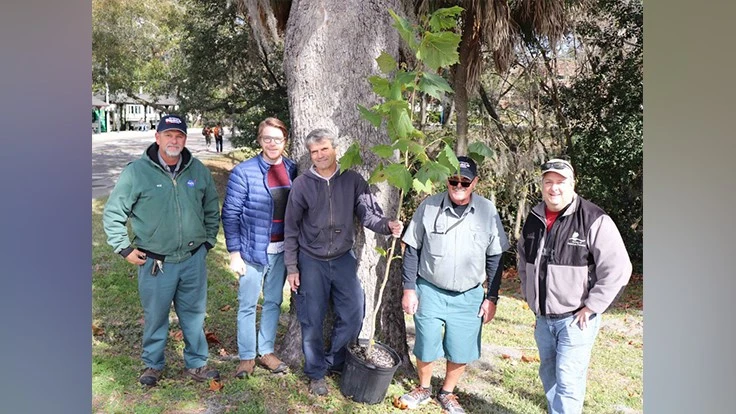
Image courtesy of the UF/IAS blog.
After a special tree at the Kennedy Space Center Visitor Complex was destroyed from Hurricane Irma, scientists from UF/IAS have provided an amazing donation, reported the UF/IAS blog.
The tree, referred to as the “Moon Tree,” is special because of its extraordinary journey: In 1971, the seed spent two weeks in micro-gravity aboard Apollo 14, and traveled to the moon and back. After it landed back on earth, it was cultivated into a sycamore tree sapling, and then planted at the Kennedy Space Center Visitor Complex in 1976.
The tree was destroyed in Hurricane Irma’s wake in 2017.
Fortunately, astronaut Stuart Roosa brought along 500 seeds during the Apollo 14 mission, and the remaining 420 saplings were disseminated to many universities and institutions across the U.S. The University of Florida received three: one sycamore and two pine trees.
To clone the moon saplings, 10 cuttings were taken from the sycamore tree and grown in a controlled setting until new roots were formed. Due to challenging conditions, only six of the saplings survived. The strongest sapling was collected and replanted at the Kennedy Space Center Visitor Complex this past spring.
Read the story here.
Latest from Nursery Management
- Jackson & Perkins expands into Canadian market
- Green & Growin’ 26 brings together North Carolina’s green industry for education, connection and growth
- Marion Ag Service announces return of Doug Grott as chief operating officer
- The Garden Conservancy hosting Open Days 2026
- Registration open for 2026 Perennial Plant Association National Symposium
- Artificial intelligence applications and challenges
- Fred C. Gloeckner Foundation Research Fund calls for 2026 research proposals
- Harrell’s expands horticulture team with addition of Chad Keel