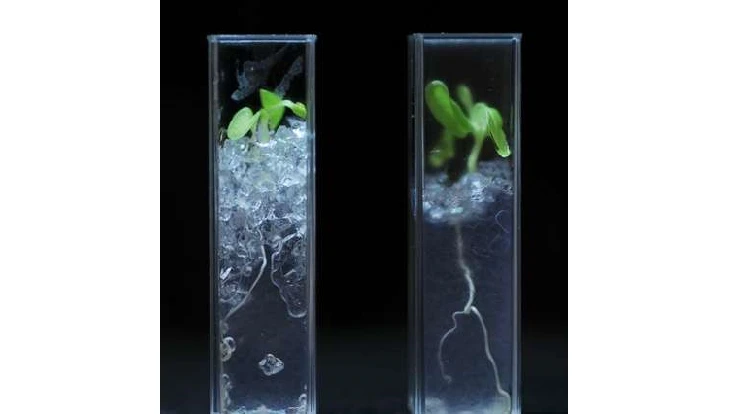
A team of researchers from the James Hutton Institute and the University of Abertay Dundee have developed a see-through soil which will enable them to study roots in detail.
Addressing global issues such as food security, disease transmission and climate change presents researchers with a variety of challenges, including the study of the underground world of plant roots; called the rhizosphere. The creation of the new see-through soil marks a milestone in the study of the rhizosphere and will have applications in many different areas of research.
Lionel Dupuy, a theoretical biologist in the Ecological Sciences group at the James Hutton Institute, said: "With this new technique, scientists now have a way to observe soil processes, live and in situ. This is exciting because there are so many things to discover in soil and we don't know yet what they are."
Click here to read more.
Latest from Nursery Management
- [SNEAK PEEK] Leading Women of Horticulture: Angela Burke
- Get to know Hailey Clark
- Get to know Brian Kemble
- Proven Winners partners with Pure Line Seeds to offer vegetable plants
- Award winners announced for 2026 PHS Philadelphia Flower Show
- Kansas City botanical garden Powell Gardens acquires IGC Colonial Gardens
- [SNEAK PEEK] Leading Women of Horticulture: Delilah Onofrey and Krystal Snyder
- [SNEAK PEEK] Leading Women of Horticulture: Alexa Patti