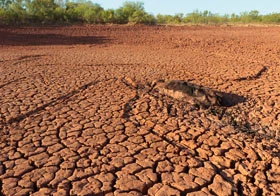
With La Niña conditions locked in place, drought conditions are expected to continue into a second year, persisting across Texas at least through May, climate experts said Tuesday at a National Oceanic and Atmospheric Administration workshop in Fort Worth.
"This is an exceptional drought, and looking ahead it's going to take more than a few rainfalls to end this," said Kevin Robbins, director of the Southern Regional Climate Center at Louisiana State University in Baton Rouge.
"Winter is the time of recharge, and unless we get two to three to four times our average rainfall, the soils are not going to be recharged."
Texas State Climatologist John Nielsen-Gammon said La Niña, which is characterized by cooler-than-normal temperatures in the Pacific Ocean, "stands for less agua in the southwestern United States."
Every La Niña on record since 1900 has resulted in below-normal rainfall for the Southwest, said Victor Murphy, climate services manager at the National Weather Service's Fort Worth office.
"The bottom line is when you are in La Niña, your chances for October-June precipitation being above normal is highly unlikely. As Yogi Berra said, 'It's deja vu all over again.' We've got another La Niña coming at us," Murphy said.
Rainfall projections strongly signal dry months into July, he said, noting that the odds are 3-to-1 in favor of drier-than-normal conditions during that period.
"November through March are among the driest months of the year in Texas, and significant drought relief this time of the year is very unlikely. April, May and June will determine if we work our way out of this drought," Murphy said. The drought began in October 2010.
North Central Texas has only a 6 to 12 percent chance of receiving enough rain from October through April to end the drought, he said.
"Conditions are ripe for the possibility of an extended drought," Murphy said.
The good news, climate experts said, is that summer temperatures, while likely to be warmer than normal, are not expected to reach the searing heights of 2011.
Klaus Wolter, a research associate at the NOAA Earth System Research Laboratory in Colorado, said the tricky part is forecasting what will happen next spring and summer.
"Odds are about 2-to-1 for a double dip" -- a second-year La Niña, Wolter said.
"I'm not predicting the drought will get worse, but the odds are stacked against us for coming out of this," he said. "As long as we stay in La Niña, there is not much hope for breaking out of the drought pattern."
That means another rough year for the agricultural industry in the Southwest, experts said.
Through August, Texas had recorded more than $5.2 billion in agricultural losses, and that number is expected to rise considerably by year's end, said Larry Redmon, state forage specialist for the Texas AgriLife Extension Service.
"We've had a disastrous year," he said.
In Oklahoma, which had its hottest summer on record, agricultural losses have topped $2 billion with nearly $440 million in hay losses, said Jim Reese, state secretary of agriculture.
"People were buying hay in April, and we've been hauling hay for an eternity now. This winter is going to be very difficult for the livestock industry," Reese said.
In Texas, ranchers have been selling off herds and trucking stock north to greener pastures, said Eldon White, executive vice president of the Texas and Southwestern Cattle Raisers Association.
In a September survey of association members, 84 percent had reduced herd sizes, he said.
"We had a lot of cows with wheels under them this summer," White said, noting that overall the number of cattle in Texas has been reduced by 600,000 to 800,000 head this year.
The projections are equally stressful for water managers.
In Texas, surface water supplies are down by about 50 percent, said Jerry Cotter of the Army Corps of Engineers in Fort Worth.
"The Metroplex is in very good shape at 70 percent capacity. The Brazos River Basin is down to about 40 percent capacity. Southeast Texas is down to about 10 percent capacity," Cotter said. "We're trying to retain enough water to last through the coming summer."
Photo by Earl Nottingham, Texas Parks & Wildlife Dept.
Latest from Nursery Management
- [SNEAK PEEK] Leading Women of Horticulture: Angela Burke
- Get to know Hailey Clark
- Get to know Brian Kemble
- Proven Winners partners with Pure Line Seeds to offer vegetable plants
- Award winners announced for 2026 PHS Philadelphia Flower Show
- Kansas City botanical garden Powell Gardens acquires IGC Colonial Gardens
- [SNEAK PEEK] Leading Women of Horticulture: Delilah Onofrey and Krystal Snyder
- [SNEAK PEEK] Leading Women of Horticulture: Alexa Patti