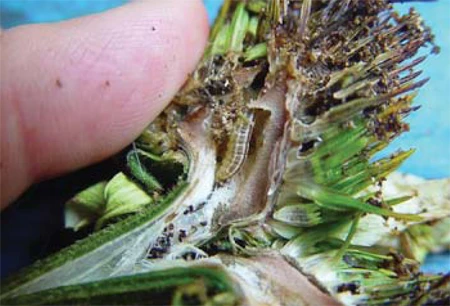
Sunflower moth (Homoeosoma electellum) is one of the most damaging pests of sunflowers and echinacea. Univ. of Md. Extension officials report the larvae have been identified on echinacea. Female adults lay their eggs at the base of the florets. Early instars feed on pollen and florets. Later instars tunnel into the flower consuming tissue and seed. Larval feeding injury provides sites for fungal disease Rhizopus head rot which can lead to complete yield loss. Growers should look for tangled mats of webbing on the flowers which are a sign of larval feeding.
Under warm temperatures a generation can be completed in 30 days. During the summer overlapping generations can occur. Controls include Bacillus thuringiensis on early instar larvae and Conserve.
Pictured:Sunflower moth (Homoeosoma electellum) larvae feed echinacea.
Photo by Carol Allen, Univ. of Md
Latest from Nursery Management
- [SNEAK PEAK] Leading Women of Horticulture: Louise Schaefer and Susan Tantsits
- The Growth Industry Episode 10: State of the Horticulture Industry
- Tennessee Green Industry Field Day scheduled for June 11
- UTIA and UT Knoxville research teams will develop automated compost monitoring system
- Ken and Deena Altman receive American Floral Endowment Ambassador Award
- [SNEAK PEEK] Leading Women of Horticulture: Becky Thomas
- [SNEAK PEEK] Leading Women of Horticulture: Angela Burke
- [SNEAK PEEK] Leading Women of Horticulture: Alexa Patti