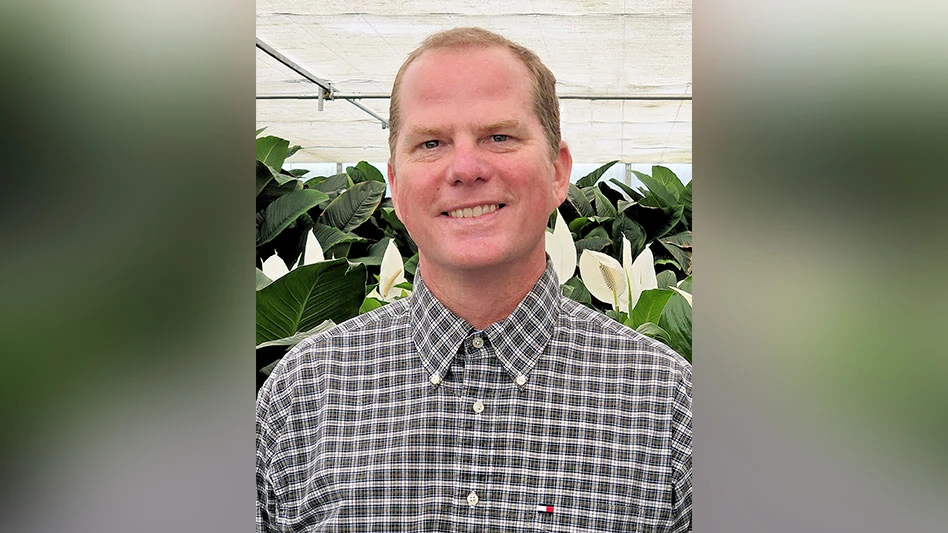
Jim Brady, owner of
“We are no longer testing plants in true cold climates,” Brady said. “I’ve harassed a lot of the people who are doing the breeding that plants need to be trialed in Northern climates. It might take four to five years to test some of these plants -- not one. We’re not seeing this done.”
Brady said he is looking for this information to pass onto his landscape and garden center customers. He said this kind of information can also help his customers promote the plants. It also can help pick which market a plant is better suited for.
“Sweet potato vine is a great plant for landscapers. They are phenomenal for the landscape, but you don’t hear much about them,” he said.
Brady tests new plants for at least two years, growing them on and planting them outside. He also gives plants to his customers to try.
“I give the plants to landscapers so that they can learn how to grow them,” he said. “I talk to garden groups and give them samples of plants. I’ll give the members my business card and ask them to send me their evaluations of the plants after a year.”
He has worked with members of the Holden Arboretum,
“Some of the plants don’t make it,” he said. “They may melt out from the heat. They may be highly susceptible to an insect or disease, or the plant habit is sloppy. Did the plants make it through the winter? That’s a big thing. Maybe we should have given the sample plants out in the spring instead of the fall so they would have a chance to become established during the summer. Those are the kinds of things that we learn.”
To help his customers be successful, Brady is creating cultural sheets for different species such as hemerocallis, lavender and hostas.
“The sheets cover both the good and bad qualities of the plants,” he said. “You have to tell them what’s good and what’s bad if you expect them to be successful. We provide information about the habit as well as the insects and diseases to which they are susceptible. We’ll let them know if the plants look bad after they’re done blooming. Plants are certainly going to have drawbacks.”
Brady said he picks out at least 10 new plants to trial every year.
“Some growers may offer 100 or more new plants every year. I feel that’s a bit much,” Brady said. “It’s of little value to push through new plants just to market them. Next year a variety may not be available, which can make it confusing for consumers.”
One example Brady cites is the number of new echinaceas released over the past three to five years. Brady said that maybe four of them are worth keeping. “Comparing some of the recent echinacea introductions with the ones currently being developed, the new ones on the market look really junky. I feel the plants aren’t being tested long enough because of the pressure to get the plants out into the marketplace.”
A threat to old, new varieties
Even though Brady produces more than a thousand plant varieties, he is seeing a change in the plant selection offered by his garden center customers.
“More garden centers only want specific plants that are in bloom,” he said. “They only want six to 10 different varieties per week. Garden centers aren’t offering the variety that they used to.”
Brady said some garden centers are being approached by merchandisers who offer to stock their tables like Pepsi and Frito-Lay does for supermarket store shelves. “One week it might be hosta, another week it might be astilbe,” he said.
The garden centers have to maintain the plants and record how many plants were sold. The company bills the garden center for plants sold. That’s how weekly specials will go through the system.
“Unfortunately, the consumers who saw the plants two weeks ago, but didn’t buy them, won’t be able to purchase the plants when they come back because they won’t be there.”
Brady said the consumers’ demand for plants in flower is going to have a major impact on what varieties will be offered in the future.
Younger gardeners (under 35) won’t buy plants if they’re not in bloom, Brady said. “The market has changed to the point where it’s becoming what’s in bloom is going to sell. Ten to 15 years ago perennials were plants that grew and bloomed and then created foliage interest.”
Brady said the recent changes in the weather and higher fuel prices have caused him to change how he produces plants.
Brady used to be able to uncover plants in March. Now he doesn’t uncover them until the end of March or the first part of April. He said retailers want plants in spring that flower and look perfect and are hardened off so they can leave them outside. “That’s not going to happen,” Brady said. “The varieties are going to change dramatically. We are going to lose many of the varieties of plants that we grow.”
Garden centers are also asking for plants to feature as weekly specials.
“We are switching in that direction because that is what the garden centers want,” Brady said. “We can easily pick out 10 items per month for April, May and June. These are the major months when people are going to be planting their gardens. July is a very touchy month.”
Concern for new pests
Even though Brady believes that new varieties are essential for the success of the industry, he is fearful of the potential danger related to the international trade of vegetative cuttings.
“There is an increasing number of pests coming into the
Growers sees a shift in container sizes
Independent garden centers accounted for 90 percent of Sunbeam’s sales when Jim Brady started his business in 1983. They now account for 60 percent of sales, with landscapers making up 40 percent.
Landscapers are looking for color that they can plant around trees and shrubs and hardscapes, Brady said. “The people who have bought homes in the last 20 years don’t know enough or have the time to install the plants. And in many cases people aren’t staying in their homes as they did in the past. So they are asking for disposable landscapes. They don’t want a tree or shrub to last 50 years. They want them to look nice for a short time. They want curb appeal; the right color to go with the house. That’s where I think the perennial market is going to go.”
Landscapers want larger sizes of materials. The landscapers’ customers want that instant color and 4-inch pots aren’t going to provide that. “One gallon or something larger seems to be where the market is headed. That’s why we are making a shift more to that larger container size,” Brady said.
Founded: In 1983 by Jim and Mary Brady.
Location:
Crops: More than 1,000 varieties of perennials and fall pansies and violas.
Market: 60 percent independent garden centers; 40 percent landscapers, mostly in
Production space: 1 acre of glass greenhouses, 2 acres of single-layer polyethylene greenhouses and 1 acre of ground beds.
Employees: Family-run operation, three full-time and three part-time. The company hires workers in fall to re-cover the poly houses.
For more:
{sidebar id=1}
- David Kuack
August 2008
Latest from Nursery Management
- Jackson & Perkins expands into Canadian market
- Green & Growin’ 26 brings together North Carolina’s green industry for education, connection and growth
- Marion Ag Service announces return of Doug Grott as chief operating officer
- The Garden Conservancy hosting Open Days 2026
- Registration open for 2026 Perennial Plant Association National Symposium
- Artificial intelligence applications and challenges
- Fred C. Gloeckner Foundation Research Fund calls for 2026 research proposals
- Harrell’s expands horticulture team with addition of Chad Keel