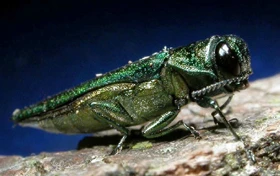
Effective immediately, the Animal and Plant Health Inspection Service (APHIS) is adding the entire Commonwealth of Pennsylvania to the list of quarantine areas for the emerald ash borer (EAB), Agrilus planipennis. Prior to this action, APHIS established quarantine areas in 43 Pennsylvania counties and the Pennsylvania Department of Agriculture established and enforced an equivalent State-level quarantine. However, on April 15, 2011, Pennsylvania rescinded its EAB quarantine. For this reason, APHIS is establishing the entire Commonwealth of Pennsylvania as a quarantine area in order to prevent the spread of EAB to other states.
The attached Federal Order outlines specific conditions for the interstate movement of EAB-regulated articles from Pennsylvania. Specifically, the interstate movement of EAB-host wood and wood products from the state is regulated, including firewood of all hardwood species, nursery stock, green lumber, waste, compost and chips of ash species.
EAB is present in some portions of the United States. Currently, Brown, Crawford, Fond du Lac, Kenosha, Milwaukee, Ozaukee, Racine, Sheboygan, Vernon, Washington, and Waukesha Counties in Wisconsin are established EAB-quarantine areas, together with the entire States of Illinois, Indiana, Ohio, Pennsylvania and West Virginia. In addition, portions of Michigan’s Upper Peninsula and the entirety of Michigan’s Lower Peninsula; Allamakee County in Iowa; 22 counties in Kentucky; Charles and Prince George’s Counties in Maryland; Arlington, Clarke, Fairfax, Fauquier, Frederick, Loudon, and Prince William Counties, along with the independent Cities of Alexandria, Fairfax, Falls Church, Manassas, Manassas Park and Winchester in Virginia; 18 counties in New York; Hennepin, Houston and Ramsey Counties in Minnesota; Knox and Loudon Counties in Tennessee; and Wayne County in Missouri are considered EAB quarantine areas.
Photo courtesy of Cornell University
Latest from Nursery Management
- The Growth Industry Episode 10: State of the Horticulture Industry
- Tennessee Green Industry Field Day scheduled for June 11
- UTIA and UT Knoxville research teams will develop automated compost monitoring system
- Ken and Deena Altman receive American Floral Endowment Ambassador Award
- [SNEAK PEEK] Leading Women of Horticulture: Becky Thomas
- [SNEAK PEEK] Leading Women of Horticulture: Angela Burke
- [SNEAK PEEK] Leading Women of Horticulture: Alexa Patti
- Native before it was cool