{tab=Weather}
The battle against the elements is never ending, but there are steps to take to help protect greenhouses and crops against Mother Nature’s dark side. Remember that old Chiffon Margarine commercial: It’s not nice to fool Mother Nature.
Weather can be a grower’s friend and foe. This climatic conundrum can catch a grower off guard when too much rain falls, wind speeds surge or conditions form more disastrous events like hail, tornadoes or hurricanes.
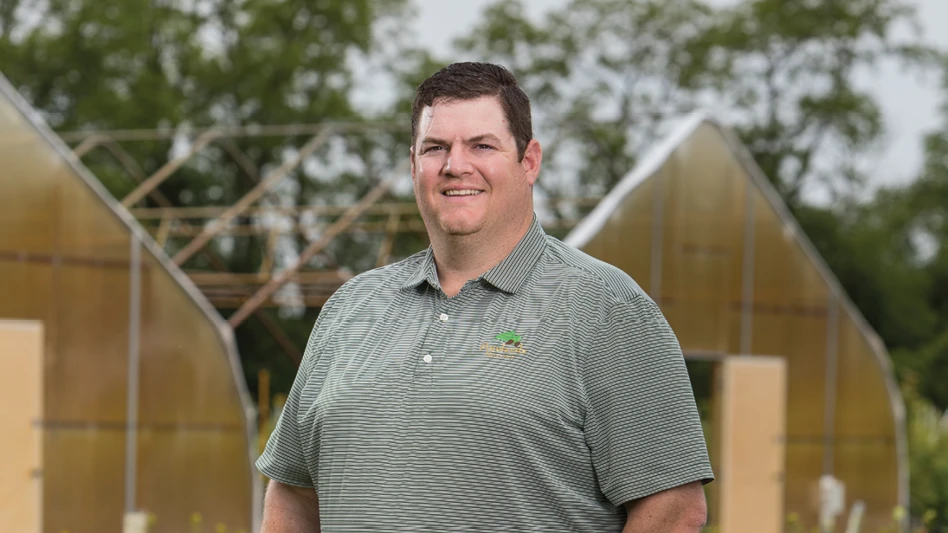
But there are safeguards to follow to protect the greenhouse against extreme weather, said Scott Thompson, vice president at X.S. Smith.
“First and foremost, make sure your insurance premiums are paid,” he said. “The structures and the crops inside are too large of an investment to let insurance slide.”
Make sure greenhouses meet or exceed local building codes.
“That’s easily addressed with the help of local officials and members of the National Greenhouse Manufacturers Association,” he said.
Thompson is the structural engineering division chairman of the association.
A weather radio is a small investment that makes a big impact. A generator is a bigger investment, but a necessary one in case of a power outage from a thunderstorm or other severe weather event.
“If you don’t have a generator, you’re just spinning your wheels,” he said. “Test it regularly and make sure it handles the load it’s been designed for.”
A solid maintenance program offers excellent protection against the weather.
“Maintain your greenhouse seasonally. A loose fastener here or a screw there can be catastrophic under the right conditions,” he said.
Greenhouse upgrades, such as an outdoor weather station tied into the environmental-control computer, provide a good weather defense.
“This technology has been around for more than a decade, but it’s fine-tuned now. Find a system that allows you to make adjustments at your facility quickly like closing shades, vents or screens,” he said.
Planning ahead
With new construction or renovation of an existing structure, planning is key.
“Look back at 50-100 years of weather data to see if the area is prone to severe conditions such as flooding,” Thompson said. “To make smart decisions, you have to look at long-term weather data.”
The weather can affect your growing operation indirectly, not just at your front door.
C. Raker & Sons in
Nationwide weather network
A devastating flood in
He formed a network of volunteers called the Community Collaborative Rain, Hail and Snow Network (CoCoRaHS). Volunteers take daily measurements of rain, snow and hail. There are now 4,500 active volunteers in 19 states.
“With all the advances we’ve had in the science of weather observation systems over the past several decades, there is still nothing that can compare to the human observer, who can report things that an automated system just can’t,” said Bruce Sullivan, a CoCoRaHS coordinator in Maryland.
The network provides solid information to big players -- the horticulture and agriculture industries, scientists, the insurance industry and the recreation industry.
“We are hopeful that CoCoRaHS reports of rain, hail and snow will not only result in a rich educational experience for all of our many participants, but also some excellent climate data for those whose work benefits from greater knowledge about local precipitation,” Doesken said.
Insurance policies for weather issues
Growers can purchase insurance coverage for both direct and indirect losses to structures and crops, said John Hodapp, senior vice president at Hortica Insurance and Employee Benefits.
Direct losses occur when property is damaged directly by a “peril,” such as lightning, wind, hail or the weight of ice, snow or sleet.
“One example includes a hurricane blowing down a greenhouse or hail penetrating a greenhouse cover,” Hodapp said. “Or a computer is damaged by a lightning strike.” Indirect losses result from a consequence of a peril. While the computer damage from lighting is a direct loss, an indirect loss would be if the computer operated the environmental-control system and the failure resulted in crop loss.
“Growers can reduce their exposures to loss by utilizing more robust versions of greenhouse covers such as tempered glass and impact-modified acrylic and polycarbonate,” Hodapp said. “Turn up the heat when snow, sleet or ice is expected. Install adequate backup heating equipment and stand-by electric generators, as well as monitoring systems.”
For more: Scott Thompson, X.S. Smith, ( 800) 631-2226; www.xssmith.com. C. Raker & Sons, (517) 542-4513; www.raker.com. Nolan Doesken,
Some annuals tolerate a dip in the mercury
“We monitor the weather really closely. If there’s an extended period of cold, we’ll institute a no-ship order if the plants are going by FedEx or by an airline,” said Carol Huntington, marketing manager at Pleasant View. “We can’t have plants sitting out on the tarmac too long in really cold weather. But it’s not a problem if the plants are going by grower truck, because the trucks are well insulated.”
Pleasant View has performed extensive tests on how long plants can be outdoors in cold weather without damage. The company even created a cool-tolerant annual program for its customers, which gives growers some wiggle room when the temperatures drop a bit. It also gives growers the opportunity to move cool-tolerant plants outdoors earlier in the season for increased turns.
Plants in its cool-tolerant program include phlox Intensia and
{sidebar id=1}
The program also features osteospermum, nemesia, calibrachoa, verbena, diascia, petunia and bidens.
For more: Pleasant
- Kelli Rodda
{tab=Sound Solutions}
Inclement weather shouldn’t dampen success
Tina Bemis, co-owner of Bemis Farms Nursery
We have learned that customers will come to our store in bad weather if you give them a really good reason. The key is to make sure we have scheduled events with a starting and ending date or time. Customers must visit during these times or they will miss something for free or something already paid for. For example, our free Easter egg hunt only happens the Saturday before Easter, and children will persuade their parents to bring them despite the weather.
During our “limited time” sales like our impatiens sale, customers must come in during the three-day event, or they will simply miss out on our best sale of the year. Some customers said they actually took the day off from work to get the best selection. They’ve come in driving rain and, one year, even sleet and snow. Make sure you make it worth their while. Make it fun, and they will be there. Our sales now begin on a weekday, which takes some of the pressure off the weekend and spreads out the weather risk.
{sidebar id=1}
Lastly, the 20 to 100 customers who’ve already prepaid for one of our container gardening workshops always come in despite the weather.
Tina Bemis is co-owner of Bemis Farms Nursery, (508) 885-4247; www.bemisfarmsnursery.com.
{/tabs}
Latest from Nursery Management
- [SNEAK PEAK] Leading Women of Horticulture: Louise Schaefer and Susan Tantsits
- The Growth Industry Episode 10: State of the Horticulture Industry
- Tennessee Green Industry Field Day scheduled for June 11
- UTIA and UT Knoxville research teams will develop automated compost monitoring system
- Ken and Deena Altman receive American Floral Endowment Ambassador Award
- [SNEAK PEEK] Leading Women of Horticulture: Becky Thomas
- [SNEAK PEEK] Leading Women of Horticulture: Angela Burke
- [SNEAK PEEK] Leading Women of Horticulture: Alexa Patti