The challenge. Although green buildings garner a lot of news coverage, what exactly makes a building “green”? Are the steps worthwhile, even if you forego being officially certified?
Switching your retail building to a green building is a good idea, financially. Not only are green buildings more energy efficient, but as zoning rules grow more environmentally conscious, you will have better resale value.
U.S. Green Building Council [USGBC] is the national leader in green building certification with its LEED certification process. Below is a list of criteria that USGBC uses for its grading system on newly constructed buildings. Keep in mind that this is a point-accumulation system, not a requirement that every item be met.
Sustainable sites
* Site selection. Reusing already developed land is better than pristine property (i.e., don’t pave paradise).
* Community connectivity and density. The denser the population (such as 10 units within an acre) within a half mile radius, the better.
* Brownfield redevelopment. Rehabilitate environmentally contaminated sites.
* Transportation. Includes bike storage and changing rooms for employees. Choose a location near public transportation. Use fuel-efficient, low-emission company vehicles, etc.
* Site development. Providing habitat protection and restoration and preserving open space.
* Storm water design. Control the amount and quality of water runoff.
* Heat island effect. What you can do to reduce the heat island effect of your site.
* Light pollution reduction. Install overnight lights that do not reflect into the sky.
Water efficiency
* Landscaping watering. Refers to reducing water use, runoff and avoiding potable water for landscaping.
* Wastewater technologies. Reduce the amount of potable water that enters the sewage system, or treating the water onsite.
* Water use reduction. Sets goals for overall water reduction.
Energy and atmosphere
* Building energy systems. This item mostly has to do with hiring a qualified “commissioner” to oversee your building’s HVAC, water heater and alternate energy systems and it’s a prerequisite for the rest of the energy and atmosphere requirements.
* Minimum energy performance. The building’s energy systems (HVAC, building envelope, lighting, etc.) meet standards of efficiency set by the international organization, ASHRAE.
* Refrigerant management. No CFC-based refrigerants (chlorofluorocarbon) used.
* Energy performance. This is a measure in energy-efficiency improvement in energy use.
* Onsite renewable energy. If your building pulls energy from onsite renewable energy sources like solar or wind, even in fairly low percentages overall, you’ll gain points.
* Green power. Earned when at least 35 percent of the building’s energy use derives from renewable sources.
Materials and resources
* Storage and collection of recyclables. Set up an onsite recycling program.
* Building reuse. If your expansion or new location uses existing buildings, you will gain points by reusing 75 percent of existing percent of walls, floors and the roof. If you reuse 90 percent, you get more points.
* Construction waste management. Recycle or salvage at least 50 percent of nonhazardous construction and demolition debris. Make it 75 percent for more points.
* Materials reuse. Devote 5 percent of your building materials (based on cost) to recycled products. Make it 10 percent for another point.
* Recycled content. Postconsumer recycled products gets more points over pre-consumer (scraps saved from the factory, but never in consumer use).
* Regional materials. Use materials extracted, processed and manufactured within 500 miles for a minimum of 10 percent of the building materials. Boost the percentage to 20 percent to earn another point.
* Rapidly renewable materials. Use materials made from rapidly renewable source (defined by USGBC as “plants that are typically harvested with a 10-year cycle or shorter) for 2.5 percent of the total value of all building material.
* Certified wood. A minimum of 50 percent of wood-based materials must be certified through the Forest Stewardship Council.
Indoor environmental quality
* Minimum indoor air quality performance. Systems must meet minimum requirements set by ASHRAE.
* Environmental tobacco smoke control. Either eliminate indoor smoking or designate a room with powerful scrubbers. Outdoor smoking areas must be at least 25 feet away from entrances, ventilation systems or operable windows.
* Outdoor air delivery monitoring. Monitor carbon dioxide levels within all densely occupied spaces, with monitors placed 3-6 feet above the floor.
* Increased ventilation. Meet air ventilations standards, which vary for mechanically and naturally ventilated spaces.
* Indoor air quality management plan. Meet air standards during construction and before occupancy.
* Low-emitting materials. Paint, coatings, carpets, adhesives, sealants, etc. must meet a standard.
* Indoor chemical & pollutant source control. Use systems designed to minimize outdoor pollutants from entering interior space.
* Controllability of systems. Provide control of lighting and thermal controls to those using individual spaces.
* Thermal comfort. HVAC and building envelope design meets AHSRAE requirements, and compliance can be verified.
* Daylight and views. Daylight glare is kept at a manageable level. Provide direct line of sight to the outdoors to a high percentage (90 percent) of regularly occupied areas.
Innovation and design process
{sidebar id=3}
* Innovation in design. This category is an opportunity for creative designs that go beyond current standards to be rewarded.
* LEED-accredited professional. At least one major member of the project team is a LEED-accredited professional.
For more:
-
August 2008
{tab=Suggestions}
Check on local incentives. As part of your planning process, check into what local incentives are available to you. There may be particular hoops you’ll need to jump through, and if you familiarize yourself at the planning stage you can decide if the incentives make the project cost effective enough.
Many local governments and civic organizations offer financial incentives to homeowners and buyers to improve their property in a green way. When you look into local incentives, you may find that many projects you deem too expensive are much less so due to 50 percent rebates, powerful tax write-offs, etc. Somewhere in the U.S., just about everything can be subsidized, from no-runoff landscape watering systems (less than $1,000) to installing solar panels (about $25,000 per panel).
Talk to your landlord about sharing costs. If you lease your property, consider using green improvements to your property when negotiating your next lease. With real estate soft, you are in a strong position to gain better terms. You can save money in the long term if your landlord is willing to use green principles in property improvement projects.
Pick the low fruit. The goal of green buildings is to be more energy efficient. Not every option is state of the art and extensive. Simple projects like checking and improving insulation and painting your rooftop white can make an immediate difference.
Think about resale value and future zoning laws. Green regulations have arrived a lot faster than many expected, and what we’ve seen so far is just the beginning of a long-term trend. While you may gain grandfathered status with new, local zoning, you will likely be required to replace any equipment with energy-efficient versions and any expansions you undertake will be held up to current standards. When you pass on your business to the next generation or sell it altogether, whoever owns your property may also need to comply with current codes. So the greener your existing structure, the higher your value will be.
{tab=Reality check}
Getting certified as a green building involves a lot of bureaucracy. Here are some examples of the smaller pieces of the puzzle that is helping us get certified:
* Proper air filtration, changed every three months.
* Doormats changed weekly. Not tracking in dirt and dust.
* Nontoxic paint and adhesives we used in constructing the building.
* Use geothermal heat (a system already in place when the property was purchased).
It’s a lot of paperwork and tracking. And being conscious on all levels of the construction of the building.
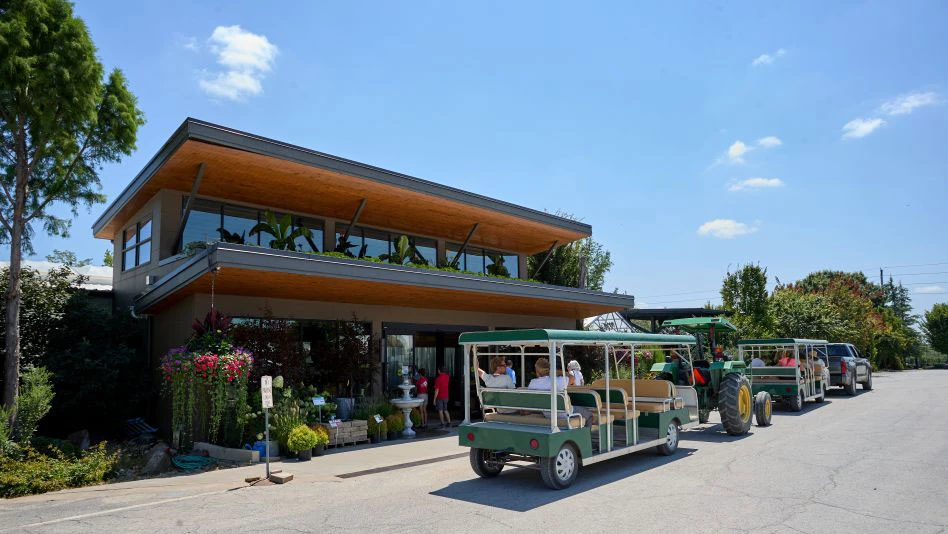
Our architect is the lead in the certification for us. Having a green architect on board made a big difference. He made the eaves 12 inches longer and angled it a little differently in order to get shade in the afternoon. Even just angling the building on the property gives us shade.
But these kinds of details can be very time consuming. For instance, you have to get all your building materials within 500 miles radius to get credit. All our pavers and bricks are manufactured locally. It does cost a lot more.
At the time, when this building was done two years ago, it was still a new concept. Today, the green aspect is more attainable. There are a lot more contractors aware of what’s involved and are being trained.
We had to figure out how to do it. And had to allow other people to figure out how to do it.
Would we do it over again? I don’t know.
Now, there is easier access to products. Before, we were the third business in the whole city to do this. We’ve learned a lot. I don’t know if the owners would do it again. People like the Tertlings [the owners] are very forward leaning.
It was the right thing to do for the future. This wasn’t a short-term change to get attention. People are in awe of the building. The building has made all of us think about what we are doing and we are taking it out into the community.
- Brenda Brien
Manager, 36th
{tab=Product feature}
Organic soil amendments
When it comes to organic growing of container plants and bedding plants, there are very few differences from regular growing. The trick is to use the right organic tools from the start. Here, we picked a few key categories for going green with your containers and bedding plants.
|
Category |
Products |
What you need to know |
|
Growing media |
Organic planting mixes and soilless mixes. |
It can also improve soil that is too sandy or made of too much clay. Soilless mixes are formulated to provide proper conditions of aeration, drainage and water retention. Among ingredients to look for: compost, peanut hulls, aged pine bark, lava sand, coir, diatomite, earthworm castings, aged pecan shells, sheep manure, cotton burr compost, rabbit manure, expanded shale, soft rock phosphate, sea minerals, bat guano. |
|
Fertilizers |
Dry and liquid fertilizers, fertilizer spikes with ingredients like seaweed, fish emulsion, manure, worm castings, bone meal, etc. |
Organic fertilizers feed plants slowly without a sudden change in the composition of the soil while improving soil quality by promoting beneficial microbial growth. Without the use of fertilizers, most container plants will not sustain a sufficient supply of nutrients through the growing season. In addition to N, P and K, plants need other elements in smaller quantities for proper growth and development : magnesium (Mg), iron (Fe), calcium (Ca), boron (B), zinc (Zn), manganese (Mn), sulfur (S) and others. |
|
Supplements |
Compost |
Compost can be a soil rejuvenator designed to add nutrients and organic matter to container plants, especially those that are overdue for repotting or are growing in poor soil. Compost can also add an extra kick to seed-starting mixes. Additionally, adding compost can provide moisture retention for sandy soils. |
|
Supplements |
Beneficial insects |
Earthworms, ladybugs and lacewings are among the many beneficial insects that can enhance a container garden’s success. Using earthworm castings in a small amount in or around houseplants, vegetables and flowers can aid in many ways by creating an extremely dark and rich texture with higher nitrogen content. |
{/tabs}
Latest from Nursery Management
- The Growth Industry Episode 10: State of the Horticulture Industry
- Tennessee Green Industry Field Day scheduled for June 11
- UTIA and UT Knoxville research teams will develop automated compost monitoring system
- Ken and Deena Altman receive American Floral Endowment Ambassador Award
- [SNEAK PEEK] Leading Women of Horticulture: Becky Thomas
- [SNEAK PEEK] Leading Women of Horticulture: Angela Burke
- [SNEAK PEEK] Leading Women of Horticulture: Alexa Patti
- Native before it was cool