Often, taking that first leap of faith into all-new territory proves to be the most difficult part of the journey. Fear of the unknown and thoughts of the “what ifs” can make you second guess your decision.
Joel DiBernardo, head grower at Creek Hill Nursery, knows the feeling. In 2010 he started experimenting with biocontrols at the young plant nursery primarily in response to pesticides being taken off the market and problems with insect resistance.
With the nursery’s 500 different perennial plugs comes a diversity of foliage and flowers, and instituting a biocontrol program required a lot of education.
“There was a major learning curve, and the process was so completely different from what we’d been doing for years,” he says.

He attended a seminar hosted by Sound Horticulture, a biocontrol firm in Bellingham, Wash., which helped answer a lot of questions, he says.
“We came away from that seminar saying ‘we can do this,’” he recalls.
The Leola, Pa.-based nursery also hired Sound Horticulture’s Alison Kutz to help get the program started.
“A consultant can lessen the intimidation of the plethora of wasps, beetles, mites and nematodes, which we now know are ‘good bugs.’ Alison also helped us come up with a cost-effective biocontrol plan,” he says.
One of the biggest lessons learned in the beginning was how to maintain thresholds of the good bugs and how to react differently when a population of whitefly or aphid shows up, he says.

“We learned to apply predators and wait. Sometimes it takes a week or two. That was a tough adjustment,” he adds. “Predators aren’t a quick-release thing. You have to develop a habitat for them and maintain that habitat so they’ll have things to eat and a place to hang out.”
One of the key aspects to a successful biocontrol program is a rigorous scouting plan. Each week, the Creek Hill team scouts crops for both pests and predators.
“When I first told our growers they had to scout weekly and fill out a report, it was a challenge for them not to be dragged down by the monotony,” he says. “Eventually the scouts started seeing all this naturally occurring insect life appear on the plants. Almost weekly, one of the growers would ask, ‘What’s this bug?’ while holding out a leaf. Their enthusiasm is also making this a success.”
Laura Buck, who came to Creek Hill about six years ago, has taken the biocontrol program “to the next level” and is constantly researching and bringing new ideas to the nursery, DiBernardo says. “Laura is adept at monitoring and identifying pests, as well as learning everything she can about the predators. She monitors all the activity. Her enthusiasm is what makes this program work so well for us,” he says.
Click here to read the full article in our April digital edition.
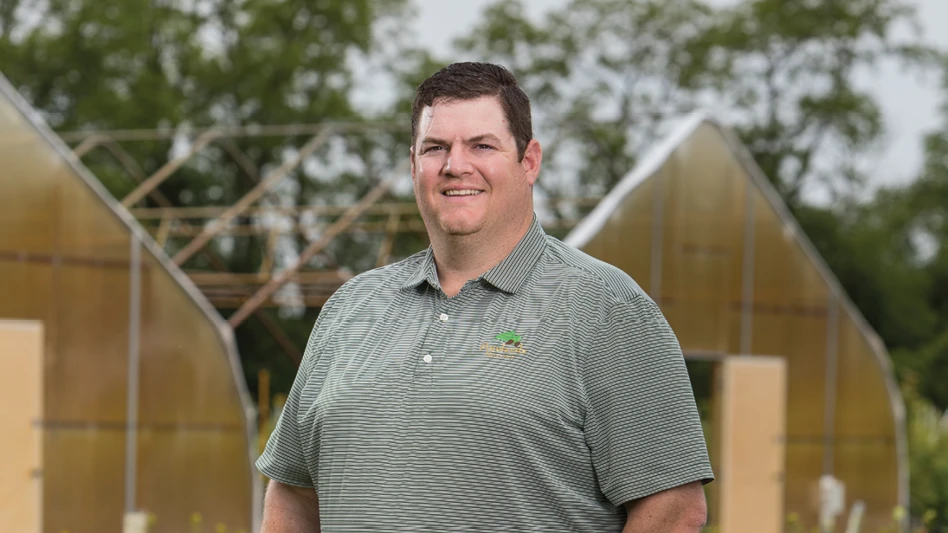
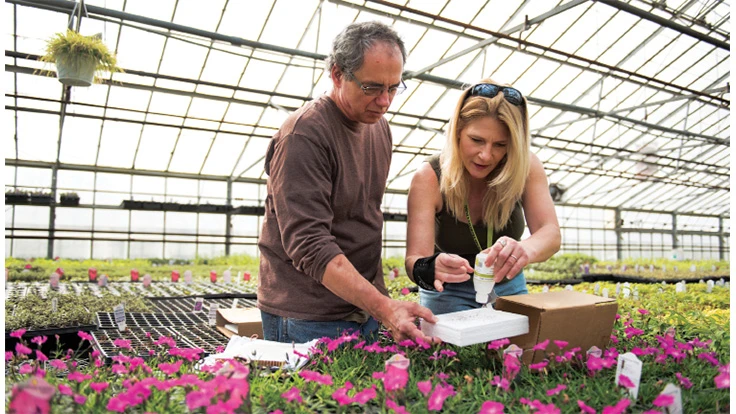
Top photo: Joel DiBernardo, head grower, and Laura Buck, grower and biocontrol manager, release Aphidius ervi, parasitic wasps that control aphids.
Latest from Nursery Management
- [SNEAK PEAK] Leading Women of Horticulture: Louise Schaefer and Susan Tantsits
- The Growth Industry Episode 10: State of the Horticulture Industry
- Tennessee Green Industry Field Day scheduled for June 11
- UTIA and UT Knoxville research teams will develop automated compost monitoring system
- Ken and Deena Altman receive American Floral Endowment Ambassador Award
- [SNEAK PEEK] Leading Women of Horticulture: Becky Thomas
- [SNEAK PEEK] Leading Women of Horticulture: Angela Burke
- [SNEAK PEEK] Leading Women of Horticulture: Alexa Patti