
Photo: Eskalen Lab, UC Riverside
In late winter 2012, scientists became aware of a new insect/disease complex that causes a Fusarium dieback on avocado and other host plants in Southern California. The disease is caused by a new, yet unnamed Fusarium sp. that forms a symbiotic relationship with a recently discovered Euwallacea sp. beetle, which serves as the vector. This beetle is morphologically indistinguishable from the tea shot hole borer, Euwallacea fornicatus (an exotic Asian ambrosia beetle). The Center for Invasive Species Research proposed the common name Polyphagous Shot Hole Borer based on the large differences in DNA sequence between the beetle invading California, and beetles from tea plantations in Sri Lanka and other Asian collection sites.
A panel of experts will discuss the beetle at the Nursery Polyphagous Shot Hole Borer and Fusarium Dieback Conference, to be held Feb. 21, from 9:30 a.m. to 1:30 p.m. at the Ahmanson room of the Huntington Library, Art Collection and Botanical Gardens, 1151 Oxford Road, San Marino, Calif. The conference is being sponsored by the Nursery Growers Association, California Department of Food and Agriculture, L.A. County Ag Commissioner, University of California-Riverside, and U.C Cooperative Extension.
The conference will cover regulatory status and actions for PSHB, biology and distribution, control tips, and a field tour of symptomatic trees.
PSHB is very small and hard to see. The beetle holes penetrate ~1-4 cm (0.4-1.57 inch) into the wood. There are often many exit holes on an infested tree. Females are black colored and about (1.8 – 2.5) mm (0.07-0.1 inch) long. Males are much less common than the females, and rarely found. They are small, wingless and brown colored, about 1.5-1.67 mm (0.06-0.065 inch) long. The exit hole is about 0.85 mm (0.033 inch) in diameter.
The new Fusarium species is inoculated into its hosts by the beetle. The fungus destroys the food and water conducting systems of the tree, eventually causing stress and dieback. The larvae of the beetles within the beetle gallery in infected trees feed on the fungus, forming a symbiotic relationship the fungus and beetle.
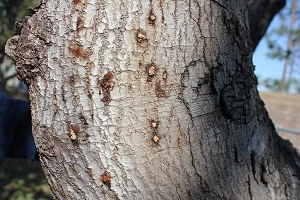
Fusarium dieback symptoms include White powdery exudate either dry or surrounded by wet discoloration of the outer bark in association with a single beetle exit hole. While there is no visible injury to the bark at this stage of colonization, examination of the cortex and wood under the infested spot bored by the beetle reveals brown discolored necrosis caused by the fungus.
At present, the beetle/fungus have been recorded from about 100 species of woody plants, including such native trees as Coast live oak (Quercus agrifolia), California Sycamore (Platanus racemosa), Big leaf maple (Acer macrophyllum), and American sweet gum, (Liquidambar styraciflua), box elder (Acer negundo) and black locust (Robinia pseudoacacia). Non-native trees and vines which have been found to host the beetle include Avocado (Persea americana), English oak (Quercus robur), Castor bean (Ricinus communis), Mimosa (Albizia julibrissin), Olive (Olea europea) and Wisteria vine (Wisteria sinensis).
Both the fungus and the beetle were found on several backyard avocado trees in residential neighborhoods and commercial avocado groves in South Gate, Downey and Hacienda Heights, and several public arboretums in Los Angeles and Orange Counties.
Avocado, box elder, coast live oak, sweetgum, and wisteria are in very different botanical families (Laureaceae, Aceracae, Fagaceae, Hamamelidaceae, Fabaceae ) -- so the host range could be quite large, according to forest insect and disease website Don't Move Firewood.
For conference registration, call (888) 502-5197 or e-mail Claudette Lerma, NGA administrative assistant at Claudette@nurserygrowers.org.
For more information about PSHB, click here.
Latest from Nursery Management
- [SNEAK PEAK] Leading Women of Horticulture: Louise Schaefer and Susan Tantsits
- The Growth Industry Episode 10: State of the Horticulture Industry
- Tennessee Green Industry Field Day scheduled for June 11
- UTIA and UT Knoxville research teams will develop automated compost monitoring system
- Ken and Deena Altman receive American Floral Endowment Ambassador Award
- [SNEAK PEEK] Leading Women of Horticulture: Becky Thomas
- [SNEAK PEEK] Leading Women of Horticulture: Angela Burke
- [SNEAK PEEK] Leading Women of Horticulture: Alexa Patti