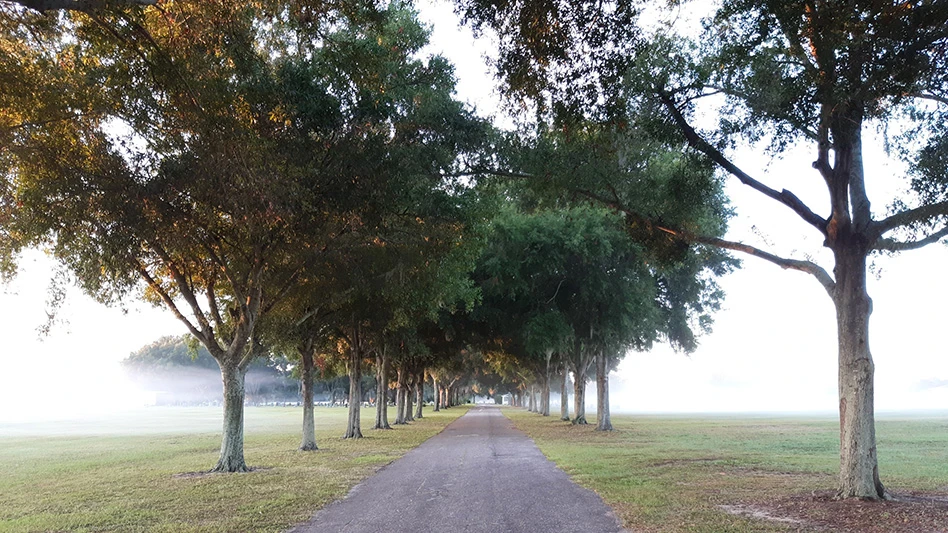
Planetrees are prized for their tolerance of urban conditions. Platanus x acerifolia ‘Morton Thornhill,’ a
“This particular tree works very well in parking lot islands, media strip plantings, as a residential street tree or landscape shade tree,” said Chad Osborn, manager of plant introduction for Chicagoland Grows.
Other features raise ‘Morton Thornhill’s street credentials even more. The tree resists anthracnose and has a good central leader and uniform pyramidal shape. It’s also winter hardy, with no reported problems with frost cracking.
Growers confirm that ‘Morton Thornhill’ can stand up to adverse conditions.
“According to our reviews from growers out west in the Illinois area, they find that it’s phenomenal as a field tree,” Osborn said. “It’s gone through droughts here and floods and growers said it hasn’t missed a beat.”
Nursery owners also said powdery mildew, which often rears its head in planetree production, hasn’t been problem with this tree.
Strong roots
‘Morton Thornhill’ resulted from a controlled cross by George Ware at the Morton Arboretum. Ware crossed an Oriental plane (P. orientalis) from the U.S. National Arboretum with an anthracnose-resistant American plane (P. occidentalis) at the Morton Arboretum.
Mature trees reach 60 feet tall and 45 inches wide. ‘Morton Thornhill’ prefers full sun, but will tolerate a wide range of soils. It’s hardy in USDA Hardiness Zone 4-8. It’s also a fast grower. Young trees grow 3 feet per year. Then growth slows to roughly 1 1/2 feet per year until it reaches maturity. The tree is densely branched, particularly as a young tree.
In summer, ‘Morton Thornhill’ has large, bright-green, deeply palmate-lobed foliage. A brief display of yellow color appears in fall. As the tree matures it will produce winter fruit, adding to its interest. The round, 1-inch balls usually appear in pairs per stalk.
From an early age, ‘Morton Thornhill’ develops attractive exfoliating bark. The bark peels off in large plates, revealing patches of interior bark in varying stages of creamy white.
The tree is easily produced through softwood cuttings. Clonal propagation is required, as plants propagated from seed will not be true to type.
Ash replacement
It appears that ‘Morton Thornhill’ came along at just the right time. The tree is touted as a good alternative to ash, which has been threatened by emerald ash borer in recent years.
Two additional London planetrees resulting from Morton Arboretum’s breeding program can also serve as ash replacements. ‘Morton Euclid’ (trademark name Ovation) has a slightly wider spread than ‘Morton Thornhill.’ The second introduction, ‘
Specifics
Name: Platanus x acerifolia ‘Morton Thornhill’
Common name: London planetree.
Family: Platanaceae.
Description: London planetree with a strong central leader and uniform pyramidal shape. The tree is densely branched, particularly as a young tree.
Propagation: Cuttings.
Hardiness: USDA Hardiness Zones 4-8.
Uses: Good urban tree. Works well in parking lot islands, media strip plantings, and as a residential street tree or landscape shade tree.
{sidebar id=2}
For more: Chicagoland Grows, (847) 835-8301; www.chicagolandgrows.org.
- Sarah Martinez
April 2008
Latest from Nursery Management
- Jackson & Perkins expands into Canadian market
- Green & Growin’ 26 brings together North Carolina’s green industry for education, connection and growth
- Marion Ag Service announces return of Doug Grott as chief operating officer
- The Garden Conservancy hosting Open Days 2026
- Registration open for 2026 Perennial Plant Association National Symposium
- Artificial intelligence applications and challenges
- Fred C. Gloeckner Foundation Research Fund calls for 2026 research proposals
- Harrell’s expands horticulture team with addition of Chad Keel