 They say timing is everything. That was the case for the Central Virginia Nursery & Landscape Association's (CVNLA) participation in a recent community project.
While many of the members do service projects on their own, the group wanted to do one together. They were talking about working with Habitat on a community service project, when a week later an opportunity fell right in to their collective laps – The Pillars at Oakmont, Richmond Metropolitan Habitat for Humanity’s multi-family, mixed-income development.
“Jack Thompson with Richmond Habitat came to Glen Allen Nursery looking for help with the plants for The Pillars and in that conversation mentioned if we knew of anyone who could do the installation,” said Jim Hassold president of CVNLA and sales manager at Glenn Allen. “Upon mentioning this opportunity to our Board, we immediately accepted the invitation to help with the planting.”
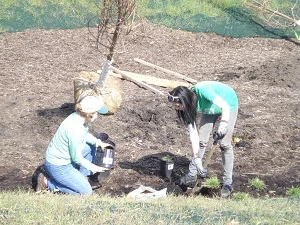
The project was broken down into two phases. The first phase, which was planted in late February, consisted of 125 native trees, shrubs and perennials along a buffer area and in the water retention pond area at The Pillars.
More than 20 CNVLA members took about three hours to help with the installation of the plants, were rewarded with a hotdog cookout. More native plants will be installed around the completed homes during phase two, which should happen in late April.

“In Virginia, there has been a concerted effort on the behalf of the Virginia Department of Conservation and Recreation’s Plant more Plants Program to encourage planting native plants in the landscape to help mitigate stormwater pollutants from entering our local streams and, eventually, the Chesapeake Bay,” Hassold says.
The native plants made The Pillars a perfect choice due to the sustainable design of the development. In the planning stages of this development, RMHFH partnered with the American Institute of Architects Committee on the Environment (COTE) to develop sustainable designs for the Pillars at Oakmont, says Kristin Vinargo, communications manager for the Richmond Metropolitan Habitat for Humanity
“The development is a prime example of green, sustainable building practices,” she says. “Energy efficiency and environmental friendliness were taken into consideration in every step of building this neighborhood, from the planning stages all the way to completion.”
Hassold said he hopes service projects become a regular occurrence with the CVNLA.
“Although this is the first team project that the CVNLA has taken on in some time, with the positive feedback we’ve received from this planting, we are looking for additional projects and hope to work on at least two or three each year,” he said. “Planning and having an enthusiastic membership are the most important aspects in successfully completing one of these projects.”
Latest from Nursery Management
- [SNEAK PEEK] Leading Women of Horticulture: Becky Thomas
- [SNEAK PEEK] Leading Women of Horticulture: Angela Burke
- [SNEAK PEEK] Leading Women of Horticulture: Alexa Patti
- Get to know Hailey Clark
- Get to know Brian Kemble
- Proven Winners partners with Pure Line Seeds to offer vegetable plants
- [WATCH] Taking root: The green industry’s guide to successful internships
- Award winners announced for 2026 PHS Philadelphia Flower Show