Periwinkle (Catharanthus roseus) has proved to be an effective screening tool for treatments to control the bacterial disease Huanglongbing known as citrus greening. Caused by 3 closely related bacteria species, there is no known cure and no established effective treatments for the disease. It is a threat not only to the citrus industry in Florida, where it was discovered in 2005, but to citrus nationwide.
A team of scientists from the USDA-Agricultural Research Service and the Univ. of Fla. Indian River Research and Education Center have found that periwinkle performs well as a stand-in for citrus, becoming quickly infected with the bacteria and responding well to antibiotic compounds tested to reduce infection.
The researchers used disease-infected lemon trees to infect periwinkle plants and then conducted greenhouse experiments to find the optimal nutrient and soil treatments for regenerating periwinkle with high infection rates. The researchers also soaked infected periwinkle cuttings in different chemical compounds and found that two of them, penicillin G sodium and biocide 2,2-dibromo-3-nitrilopropionamide (DBNPA), performed well as potential treatments. The chemicals must still be evaluated in field trials and require approval by regulatory agencies before commercial use is possible. Results of the research are published in the journal Phytopathology.
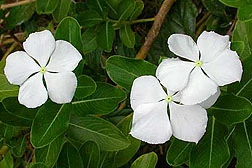
Pictured: Periwinkle has proved to be an effective screening tool for control treatments of Huanglongbing, also known as citrus greening. Photo courtesy of National Park Service
Latest from Nursery Management
- Jackson & Perkins expands into Canadian market
- Green & Growin’ 26 brings together North Carolina’s green industry for education, connection and growth
- Marion Ag Service announces return of Doug Grott as chief operating officer
- The Garden Conservancy hosting Open Days 2026
- Registration open for 2026 Perennial Plant Association National Symposium
- Artificial intelligence applications and challenges
- Fred C. Gloeckner Foundation Research Fund calls for 2026 research proposals
- Harrell’s expands horticulture team with addition of Chad Keel