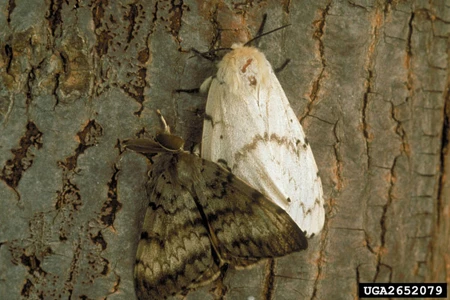
Gypsy moths wreak havoc, but their own enemies are not far behind
If you live in a section of the country where gypsy moths are a relatively new menace, have no fear, help is not far behind.
Cornell University entomologist Ann Hajek told a national conference earlier this month when the gypsy moth – whose caterpillars have defoliated entire forests – started spreading westward more than 100 years ago from New England to Wisconsin, its fungal and viral pathogens followed close behind.
“We were pretty surprised,” Hajek said. “No one knew how long it took the pathogens to chase their hosts.”
The findings are important because gypsy moth populations can develop unpredictably and erratically, with lots of caterpillars eating all the leaves off of most of the trees, Hajek told attendees at Cornell’s Ecology and Evolution of Infectious Disease workshop and conference earlier this month.
Gypsy moths are slowly moving west across the United States after being introduced to Massachusetts from Europe in 1869. They migrate slowly because the females do not fly. By tracking the edges of the migration, where population densities are low, researchers have an opportunity to investigate how long it takes their viral and fungal pathogens to catch up, she said.
The fungal pathogen, Entomophaga maimaiga, attacks the caterpillars and was first reported in 1989. The virus, Lymantria dispar nucleopolyhedrovirus, which was accidentally introduced near Boston in 1906, also infects gypsy moth caterpillars.
Hajek and colleagues studied “leading edge” populations of moths and pathogens in central Wisconsin in 2005-07. They set pheromone traps west of the migrating population and then traveled east to lay traps to catch the flying males. Once their traps caught more than 74 moths each in single year, there was a more than 50 percent chance of finding the fungus in that area in the following year. When more than 252 moths were trapped in a year, there was more than 50 percent chance of finding the virus the next year.
“Our data show that the fungus spreads into lower density leading edge populations sooner than the virus, but the virus eventually colonizes the populations, too,” she said.
Fungal spores actively shoot out of the moth cadavers and disperse in the environment, thereby spreading quickly. The virus spreads from one caterpillar to another, and possibly via parasitoid flies and predators, which is a slower process, she said.
Photo courtesy of USDA APHIS
Latest from Nursery Management
- [SNEAK PEAK] Leading Women of Horticulture: Louise Schaefer and Susan Tantsits
- The Growth Industry Episode 10: State of the Horticulture Industry
- Tennessee Green Industry Field Day scheduled for June 11
- UTIA and UT Knoxville research teams will develop automated compost monitoring system
- Ken and Deena Altman receive American Floral Endowment Ambassador Award
- [SNEAK PEEK] Leading Women of Horticulture: Becky Thomas
- [SNEAK PEEK] Leading Women of Horticulture: Angela Burke
- [SNEAK PEEK] Leading Women of Horticulture: Alexa Patti