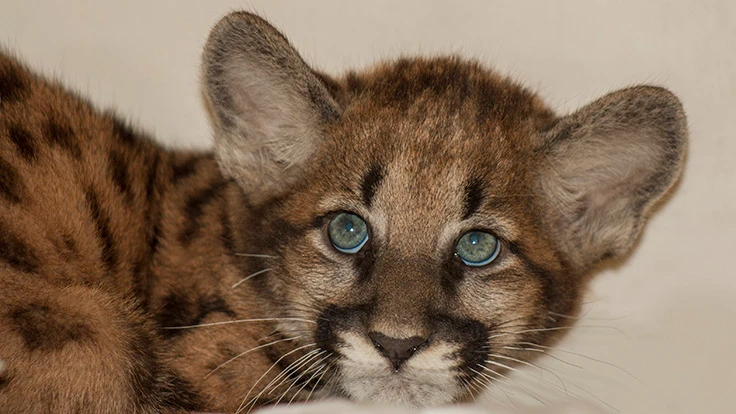
Florida, January 2016 – On Monday, January 18th, Sakata employees performing routine field maintenance found a young male panther kitten abandoned and sleeping in one of the fields of Sakata’s Research Station in Ft. Myers, FL. Although the Florida Station frequently receives wildlife visitors, such as bears and alligators, this discovery was more unusual, as not only are Florida panthers an endangered species, but the kitten was extremely young and alone (2-3 months old).
Sakata alerted Florida Fish and Wildlife Conservation Commission (FWC), who were shocked to catch wind of such a rare case – an unharmed, very young, abandoned panther kitten. A nearby zoo, Naples Zoo at Caribbean Gardens, due to their understanding of the gravity of the species possible extinction, recently constructed a facility specifically aimed at providing housing for injured or orphaned panthers found in the area. The kitten was immediately taken to the facility. Although this is only a temporary solution, it provides a safe haven for panthers to recover as the U.S. Fish and Wildlife Service (USFWS) and FWC coordinate to find permanent homes for cats that for whatever reason, cannot survive if re-released into the wild.
The panther kitten (known as UCFP261 until renamed) is no exception. After the kitten’s capture, Sakata opened its doors to tracking and monitoring to be conducted by USFWS and FWC whose research concluded that the kitten was most likely lost during a rare encounter of two mothers with kittens crossing paths in the field and the kitten attempting to leave with the wrong mother. Sakata also granted the organizations access to monitor the property to see if the lost kitten’s mother returned to the field where he was lost. She, unfortunately, did not, and because cats who are under the age of six months when brought into captivity are generally not released back into the wild because they lack sufficient survival skills due to lack of time with their mother, the decision was made to not release the kitten as odds were not great that he could survive on his own.
In the 1970s, Florida reported merely 20 to 30 cats; however, several decades of combined efforts have brought the current population up to roughly 180 adult cats today.
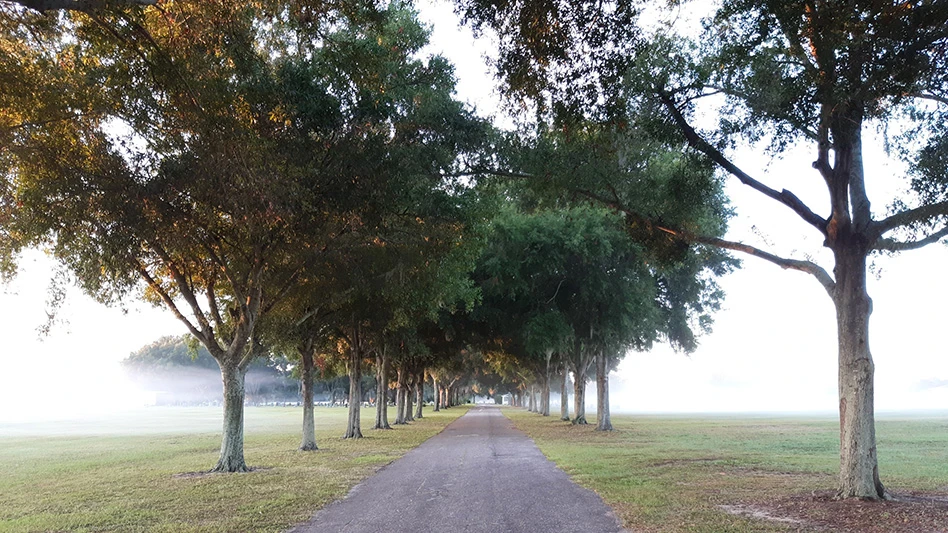
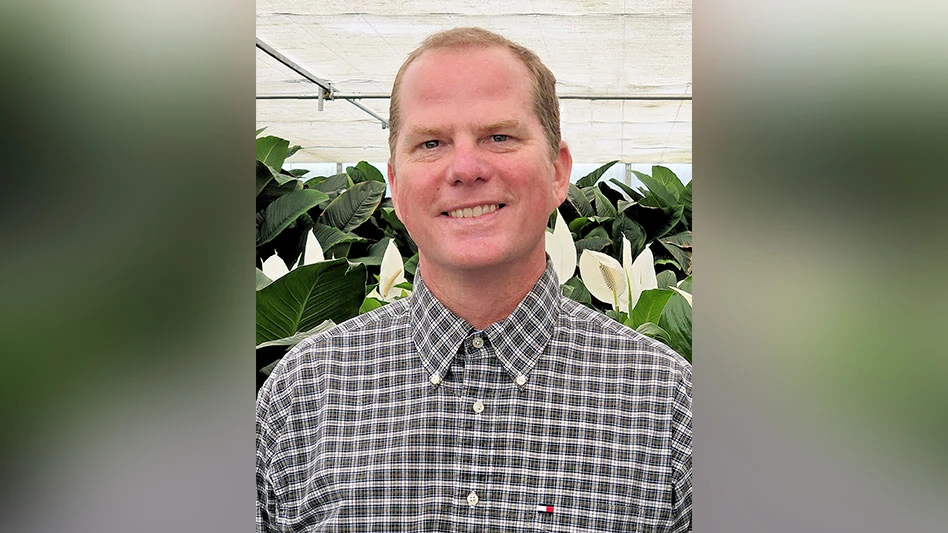
"We’ve got acres and acres of woods between us and the airport and 50 acres of our 125-acre station are natural with cypress trees and a retention reservoir. We see plenty of wildlife attracted to our area like bears, wood storks and sand hill cranes," said Randy Johnson, Florida Station Branch Manager for Sakata Seed America. "About a year ago, we started finding more panther tracks in the fields. Perhaps not coincidentally, we also started seeing fewer of the raccoons that eat our crops. Being a good steward of the land can pay off in unexpected ways.”
For more information or to follow up on the status of the panther kitten, please visit www.napleszoo.org.
Latest from Nursery Management
- Jackson & Perkins expands into Canadian market
- Green & Growin’ 26 brings together North Carolina’s green industry for education, connection and growth
- Marion Ag Service announces return of Doug Grott as chief operating officer
- The Garden Conservancy hosting Open Days 2026
- Registration open for 2026 Perennial Plant Association National Symposium
- Artificial intelligence applications and challenges
- Fred C. Gloeckner Foundation Research Fund calls for 2026 research proposals
- Harrell’s expands horticulture team with addition of Chad Keel