By Elizabeth Case
Next to the "Welcome to Oregon" sign at the Portland International Airport, a squad from the state Department of Agriculture fights a century-old battle against a determined invader, the Japanese beetle. The pest could chew through the city's namesake roses and the state's multi-million dollar nursery industry.
So far, their numbers are tiny, and Oregon remains officially Japanese-beetle free. Still, with the 32 trapped on airport lands last year, Helmuth Rogg and his team of seven expanded and fortified defenses nearby last week to prevent them from spreading statewide.
"We have zero tolerance for Japanese beetles," said Rogg, the supervisor of the state's insect pest prevention and management program, standing in a bright orange vest next to Airport Way.
Japanese beetles likely hitched a ride to America in 1916 on a boatload of iris. They are one of countless opportunistic species crisscrossing land and sea as global trade increases and the world shrinks.
Most of these insects, plants and animals are harmless, and meld well into their new homes. But others, free from their natural predators, overrun native environments. Such pests like Japanese beetles may be responsible for about 40 percent of threatened species in the United States, according to a 2004 study from Cornell University.
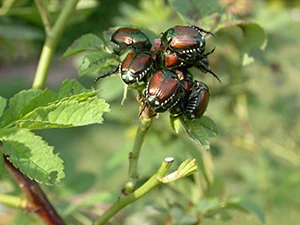
Japanese beetles are an iridescent green and brown, about the size of a thumbnail. They first exploded into large, destructive populations east of the Mississippi River. Slowly, they are marching West, feeding on turf, fruit trees, berries, hops and numerous ornamental plants.
So the last lines of defense are people like Rogg, who have few options – but plenty at stake – to control the pests. At the airport Rogg and the Agriculture Department use pheromone and scent traps to catch any adult beetles, and pesticide sprays for both shrubs and turf.
"We don't do that lightly. But you have to consider, if we don't do anything, we will have everybody else spraying," said Rogg. "It's the lesser evil."
The only natural insecticide is milky spore, soil-dwelling bacteria that kill Japanese beetle grubs, but Rogg said its effectiveness depends too heavily on uncontrollable environmental factors. He can't take that risk.
If Japanese beetles go unchecked, the state estimates they will ring up a $33 million annual tab. The damages range from destroyed plants and decimated turf in yards and golf courses to extra money for quarantine measures, which require exporters to prove plants are pest-free. The only other insect the department of agriculture worries about as much as the Japanese beetle is the gypsy moth, whose larvae eats through forests.
Read the rest of the story here.
Photo courtesy of University of Wisconsin, Madison, Department of Entomology
Latest from Nursery Management
- [SNEAK PEAK] Leading Women of Horticulture: Louise Schaefer and Susan Tantsits
- The Growth Industry Episode 10: State of the Horticulture Industry
- Tennessee Green Industry Field Day scheduled for June 11
- UTIA and UT Knoxville research teams will develop automated compost monitoring system
- Ken and Deena Altman receive American Floral Endowment Ambassador Award
- [SNEAK PEEK] Leading Women of Horticulture: Becky Thomas
- [SNEAK PEEK] Leading Women of Horticulture: Angela Burke
- [SNEAK PEEK] Leading Women of Horticulture: Alexa Patti