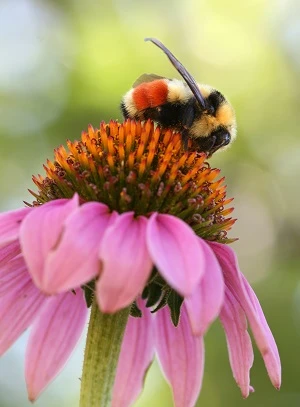
.jpg) Photo: Hunt's Bumblebee by Leah LewisOn June 27, the Oregon Department of Agriculture (ODA) announced a 180-day temporary use restriction for all plant applications – by professionals and non-professionals – of any pesticide product with the active ingredient dinotefuran. ODA has implemented the restriction as a temporary, cautionary step, allowing it to complete its ongoing investigation of a bee kill incident that occurred in mid-June in Wilsonville and Hillsboro, Ore.
Photo: Hunt's Bumblebee by Leah LewisOn June 27, the Oregon Department of Agriculture (ODA) announced a 180-day temporary use restriction for all plant applications – by professionals and non-professionals – of any pesticide product with the active ingredient dinotefuran. ODA has implemented the restriction as a temporary, cautionary step, allowing it to complete its ongoing investigation of a bee kill incident that occurred in mid-June in Wilsonville and Hillsboro, Ore.
“I have directed the agency to take this step in an effort to minimize any potential for additional incidents involving bee deaths connected to pesticide products with this active ingredient until such time as our investigation is completed and we have more information,” said ODA Director Katy Coba. “Conclusions from the investigation will help us and our partners evaluate whether additional steps need to be considered.”
A joint release from the Society of American Florists, OFA and the American Nursery & Landscape Association suggests that this accident would not have happened if the appropriate site, plant, timing, and pest considerations had been taken into account. ODA has determined that the event resulted in the death of approximately 50,000 bumblebees. Multiple Linden trees, in flower, were apparently sprayed with a dinotefuran pesticide. The SAF, OFA and ANLA release states this event serves as a reminder of the need to closely follow manufacturer and EPA-approved labeling.
The release states that neonicotinoid insecticides, including dinotefuran, are important tools that allow growers, landscapers, and homeowners to protect valuable landscape trees, shrubs and plants from insect pests and invasive species. They are important in maintaining the fight against the Japanese Beetle and have been employed in the successful eradication efforts against Asian Longhorned Beetle; in protecting important ash trees from Emerald Ash Borer; and in saving Eastern Hemlocks from Hemlock Woolly Adelgid.
“Without neonicotinoids, the iconic Hemlocks of Great Smoky Mountains National Park would be gone,” said Dr. Richard Cowles, Agricultural Scientist at the Connecticut Agricultural Experiment Station. “There’s an old carpenter’s adage that says ‘measure twice, cut once.’ That adage is a good one for insecticide applicators to think about -- read the label carefully multiple times before applying.”
The release encourages growers to be sure that the pest they want to control is on the pesticide label for the location they are planning to treat. Registered pesticides that could negatively impact bees carry a bee hazard statement on the label. The release closes with a plea to adhere to the restrictions listed on the label, usually found under “environmental or bee hazard” and a reminder that following the label is the law.
The temporary rule, which goes into effect immediately, will be enforced for 180 days, by which time ODA is expected to complete its investigations. Those investigations will determine if the pesticide applications were in violation of state and federal pesticide regulations, and will assist ODA in addressing any potential future actions. ODA’s Pesticide Program has established a website with more information on the Dinotefuran restriction, including a list of specific products affected as well as instructions for those who may have purchased these products.
Latest from Nursery Management
- Jackson & Perkins expands into Canadian market
- Green & Growin’ 26 brings together North Carolina’s green industry for education, connection and growth
- Marion Ag Service announces return of Doug Grott as chief operating officer
- The Garden Conservancy hosting Open Days 2026
- Registration open for 2026 Perennial Plant Association National Symposium
- Artificial intelligence applications and challenges
- Fred C. Gloeckner Foundation Research Fund calls for 2026 research proposals
- Harrell’s expands horticulture team with addition of Chad Keel