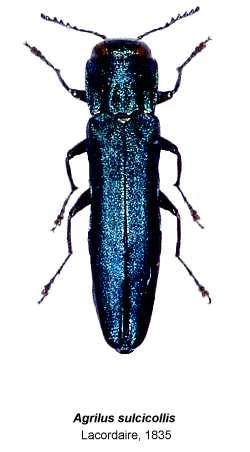
Agrilus sulcicollis is considered an economic pest that may be a factor of oak decline in Europe, but recent literature describes this beetle as more of a secondary pest. EOB prefers to infest upper parts of the stems, branches, and smaller sized host trees. The beetle also inhabits freshly cut timber. EOB is native to most of Europe, except for the northernmost parts. The larvae develop in or under bark of live Quercus species, and require between one and two years to develop before emerging as adults. The host range of EOB includes Quercus spp. (oak), Castanea spp. (chestnut), and Fagus spp. (beech).
Latest from Nursery Management
- [SNEAK PEAK] Leading Women of Horticulture: Louise Schaefer and Susan Tantsits
- The Growth Industry Episode 10: State of the Horticulture Industry
- Tennessee Green Industry Field Day scheduled for June 11
- UTIA and UT Knoxville research teams will develop automated compost monitoring system
- Ken and Deena Altman receive American Floral Endowment Ambassador Award
- [SNEAK PEEK] Leading Women of Horticulture: Becky Thomas
- [SNEAK PEEK] Leading Women of Horticulture: Angela Burke
- [SNEAK PEEK] Leading Women of Horticulture: Alexa Patti