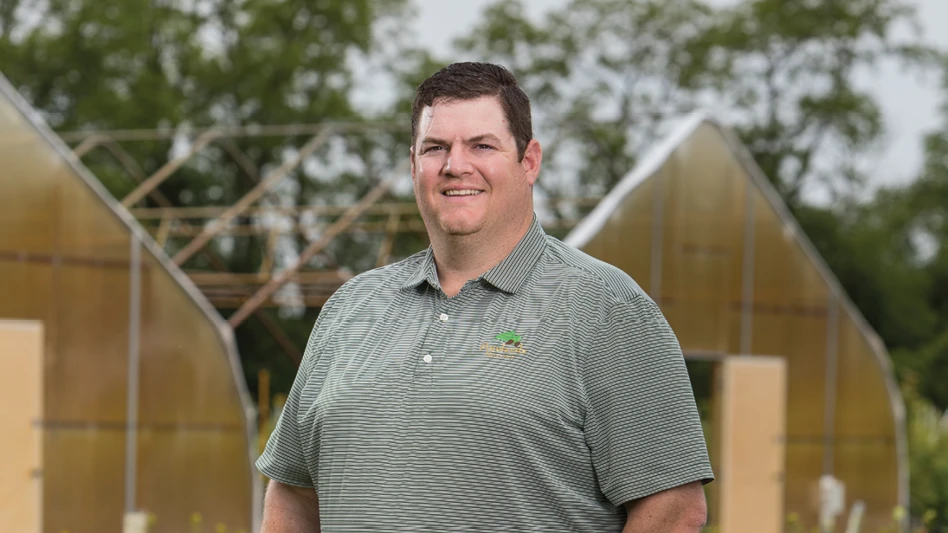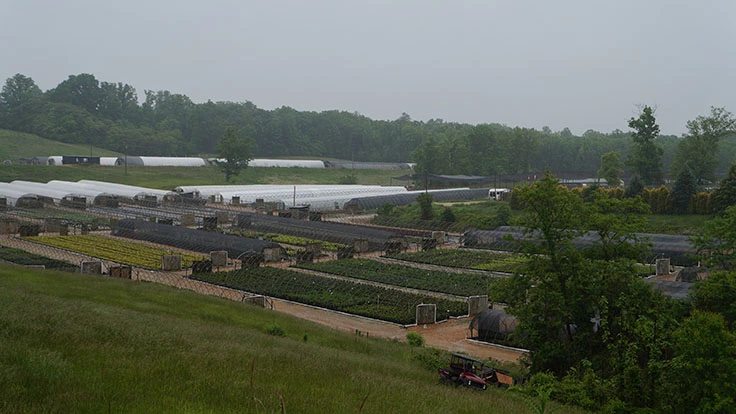
Saunders Brothers is nestled in Piney River, Va., under the shadow of the Blue Ridge Mountains. The family-owned, 100-year old nursery is known for boxwood, but also produces a wide variety of woody shrubs. Lindsay Day, propagation manager and assistant grower, estimates that Saunders Brothers propagates about 75 percent of its plants in-house, including flowering shrubs, azaleas, hollies, and of course, boxwood.
Currently, Day and the Saunders Brothers team is in the midst of conifer production. Botrytis is the biggest disease problem, but it’s hardly the only one.
“Propagation is the perfect conducive environment for a whole plethora of diseases,” Day said. “This summer, we got Pythium pretty bad, we struggled with that. We saw some Rhizoctonia, as well and Phytophthora is always a beast. Those are the big ones.”
The group works especially hard to prevent Phytophthora through the winter, because water management can be tough on liners in the winter.
“You see a little bit of powdery mildew, you see a little of the leaf spots, but it’s usually the root rot and crown rot diseases that we see the most,” she said.
Saunders Brothers uses scouting at a vital tool to prevent disease outbreaks.
Day said there is a someone scouting every single one of the propagation houses daily, looking for any sort of sign of diseases. Integrated Pest Management is another tool to prevent outbreaks. But once the cuttings are rooted or the propagation team is starting to cut back on mist, when they know disease pressure will be an issue, they begin spraying preventatively on rotation.
Day said disease pressure is usually at its highest during the second week of propagation, the week after the plants have been stuck.
“The first week, you’re on such a heavy misting cycle, because the cuttings are so tender and so fragile,” she said. “But as soon as you back off, you have to play this game of not making it too wet but not trying to harden the cuttings too fast. That’s when we tend to get the most pressure. Overwatering is the wettest environment; therefore the disease pressure is the worst.”
That’s when her team starts spraying on a biweekly rotation. Saunders Brothers uses broad spectrum fungicides and spray preventatively for boxwood blight, botrytis and other fungal pathogens – as soon as the cuttings are hardened off and the growers are able to cut back on misting.
Day uses a chemical rotation recommendation from Virginia Tech University for boxwood blight. That means the flowering shrubs and others usually get sprayed a little differently, because boxwood are on their rotation. “We use three different ones on boxwood,” she said. “We try to rotate chemical classes so it’s not even so much about product as it is about the different modes of actions we are trying to target. Most of the fungicides used for boxwood blight are broad-spectrum and knock out everything.”
Rotating chemicals is crucial to avoid disease resistance. Day said some diseases can develop resistance very easily. Growers should be careful with botrytis, for example. There are two growers at Saunders Brothers who manage quality control. They work together to handle IPM and chemical rotations for annuals, perennials, and woody shrub production.
Other growers looking to develop a plant health system should rely on extension agents and their local university. Saunders Brothers developed their system after attending several talks from experts like Ann Chase of Chase Agricultural Consulting LLC and Margery Daughtrey, senior extension associate with Long Island Horticultural Research & Extension Center, and working closely with Virginia Tech University’s plant health and disease clinic.
“We’re so close to VT that they are the easiest to contact,” Day said. “If we have a disease we need to be identified, we can send it to them and they can recommend a strategy based on the pesticide guide for Virginia. It’s just using educational materials to make a decision.”
Latest from Nursery Management
- [SNEAK PEAK] Leading Women of Horticulture: Louise Schaefer and Susan Tantsits
- The Growth Industry Episode 10: State of the Horticulture Industry
- Tennessee Green Industry Field Day scheduled for June 11
- UTIA and UT Knoxville research teams will develop automated compost monitoring system
- Ken and Deena Altman receive American Floral Endowment Ambassador Award
- [SNEAK PEEK] Leading Women of Horticulture: Becky Thomas
- [SNEAK PEEK] Leading Women of Horticulture: Angela Burke
- [SNEAK PEEK] Leading Women of Horticulture: Alexa Patti