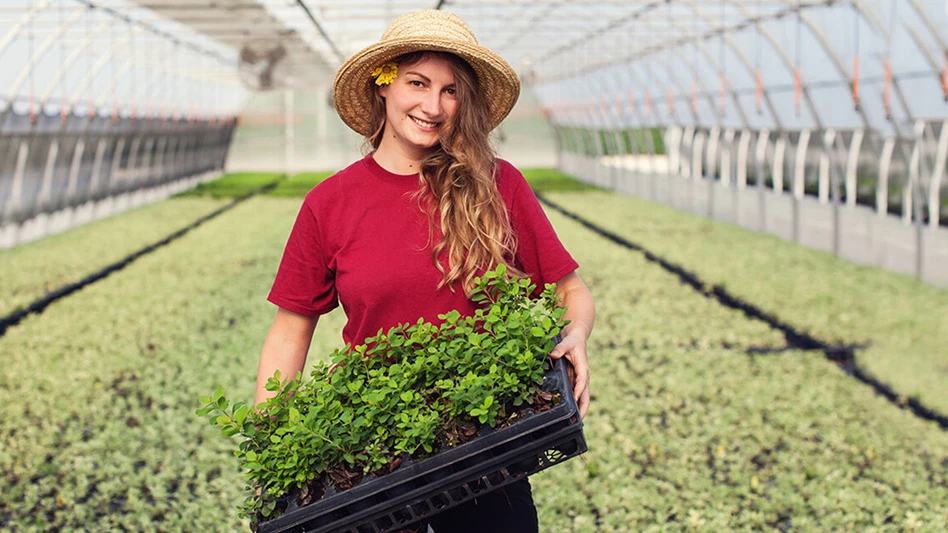
The last 75 years have been a sweet ride for the Nourse family, owners of Nourse Farms in
The nursery produces eight small-fruit species plus asparagus, horseradish and rhubarb. The majority of sales comes from strawberries and raspberries.
What started solely as a strawberry nursery with sales of less than 1 million plants, has turned into a global business with sales of more than 20 million plants a year. Nourse ships to every U.S. state, Canada, Mexico, Colombia, Korea and throughout Europe.
The small fruit market has become lucrative, especially with the focus on the health benefits of berries.
“Predictions for America to triple their berry consumption in the next decade are very realistic,” said Nate Nourse, sales director at Nourse Farms. “Berries contain the highest levels of antioxidants per unit, and people really enjoy eating things that are as good to eat as they are for their bodies.”
All of Nourse Farms’ plants are ready for sale in three to six weeks after potting. The farm sells varieties for nearly every climate, and plants do not require a lot of fussy care, whether in the nursery, at the garden center or in the home garden, he said.
“The most important tip is to keep bare-root plants from drying out, especially raspberries,” he said. “Asparagus is the exception. It must be kept dry.”
High-tech edibles
In 1982, company president Tim Nourse opened a tissue-culture lab at the farm.
“Our mission of producing top-quality plants is further supported by our tissue-culture lab,” Tim said. “Besides propagation of strawberries and brambles, our lab specializes in virus and disease detection and elimination.”
The farm also recently adopted the latest technology in RNA and DNA extraction, and polymerase chain reaction (PCR) testing, which allows the farm to offer certified planting stock.
Tried and tested
Trials are important to Nourse Farms and represent an investment in identifying new and improved varieties, Tim said. The farm primarily evaluates plants for flavor, size and yield. Plant vigor and disease resistance is equally important.
The farm trials a plant for at least three years to see if it performs under a range of conditions. Sometimes trials take up to eight years before the farm decides to add or discard a variety.
Plasticulture increases yield
Nourse Farms planted its first acre of plasticulture berries in 1994. Today, plasticulture techniques are used on all its berry plant and fruit production acreage -- with and without plastic.
Plasticulture refers to planting and growing techniques that may, or may not, involve the use of any plastic material.
“For a progressive strawberry grower, plasticulture farming begins with raised beds of dual-row strawberries planted to stand with drip-tape irrigation,” Nate said. “Plastic mulch is an option.”
Some benefits of plasticulture include superior weed controls, increased fruit size and yield and a longer potential picking season.
With plasticulture, the same variety of fruits may be harvested at three different times.
* Normal fruiting schedule: Leave straw through early spring for the same production schedule as bare ground. This is recommended for growers who don’t have frost protection.
{sidebar id=2}
* Early fruiting schedule: Remove straw in the early spring to allow early growth and fruiting. Row cover may add an additional five to seven days to earlier fruiting. Damage from frost is possible.
* Late fruiting schedule: Leave straw over plastic until late spring to promote slower growth and late fruiting.
Nourse Farms
Founded: In 1932 in
Tim and Mary Nourse acquired the business in 1968.
Locations: Whately, Hatfield and
and
Crops: Bare-root fruit plants, including strawberry,
raspberry, blackberry, blueberry, gooseberry, currant,
asparagus, horseradish and rhubarb.
Production space: 400 acres.
Market: Commercial growers, wholesale growers
and home gardeners. Nourse Farms ships product to
every
For more: Nourse Farms, (413) 665-2658; www.noursefarms.com.
- Kelli Rodda
April 2008
Latest from Nursery Management
- [SNEAK PEEK] Leading Women of Horticulture: Angela Burke
- Get to know Hailey Clark
- Get to know Brian Kemble
- Proven Winners partners with Pure Line Seeds to offer vegetable plants
- Award winners announced for 2026 PHS Philadelphia Flower Show
- Kansas City botanical garden Powell Gardens acquires IGC Colonial Gardens
- [SNEAK PEEK] Leading Women of Horticulture: Delilah Onofrey and Krystal Snyder
- [SNEAK PEEK] Leading Women of Horticulture: Alexa Patti