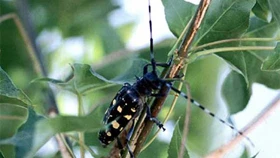

From ANLA: The USDA’s Animal and Plant Health Inspection Service (APHIS) have announced an expansion of the Asian longhorn beetle (ALB) regulated area in Clermont County, Ohio, which is situated in the southwest portion of the state. The increase in the regulated area from 56.2 to 61 square miles is a disheartening blow to eradication efforts which began in the state shortly after the pest was initially discovered in June of 2011. Unlike programs in New Jersey and New York, where ALB was found in more urban areas and eradication appears to be moving ahead successfully, Ohio has the additional challenge of dealing with this invasive and destructive pest in its forests.
To bolster the eradication effort, in mid-August the USDA announced that it would provide $15 million to Ohio to battle ALB. This is on top of the $2 million the Ohio General Assembly agreed to provide in support of the program, earlier this year. Ohio and federal regulators recognize the economic and environmental impact ALB can have on the state. The Ohio nursery and landscape industry is a multi-billion dollar economic driver in the state and the Ohio Department of Agriculture estimates that over $200 billion of standing timber are susceptible. The additional funds should improve the state’s chances of eliminating ALB. However, elimination of a pest like this is a multi-year and intensive process, as other successful ALB state eradication efforts have found.
ALB is an invasive wood boring beetle capable of infesting and killing a broad diversity of trees including many of our native and ornamental taxa — Maples (Acer), Ash (Fraxinus), Birch (Betula), Elm (Ulmus), European mountain ash (Sorbus aucuparia), Goldenrain tree (Koelreuteria paniculata), Hackberry (Celtis), Horse chestnut (Aesculus) , Katsura (Cercidiphyllum), London plane tree (Platanus), Mimosa (Mimosa), Poplar (Populus), and Willow (Salix). It was first discovered in the U.S. in Brooklyn, NY in 1996 and thought to be introduced from China through infested wooden pallets or wood packing material.
ALB is currently found in four U.S. states (MA, NJ, NY, OH) each involved in eradication efforts. However, this pest can spread easily by transporting infested firewood and wooden pallets from regulated areas. ALB is arguably the greatest insect threat to our natural and ornamental landscapes. Please visit the USDA’s Beetle Busters site to learn more about this destructive pest, how to identify it, and who to contact if necessary.
Latest from Nursery Management
- [SNEAK PEAK] Leading Women of Horticulture: Louise Schaefer and Susan Tantsits
- The Growth Industry Episode 10: State of the Horticulture Industry
- Tennessee Green Industry Field Day scheduled for June 11
- UTIA and UT Knoxville research teams will develop automated compost monitoring system
- Ken and Deena Altman receive American Floral Endowment Ambassador Award
- [SNEAK PEEK] Leading Women of Horticulture: Becky Thomas
- [SNEAK PEEK] Leading Women of Horticulture: Angela Burke
- [SNEAK PEEK] Leading Women of Horticulture: Alexa Patti