Peggy Greb/ARS-USDA
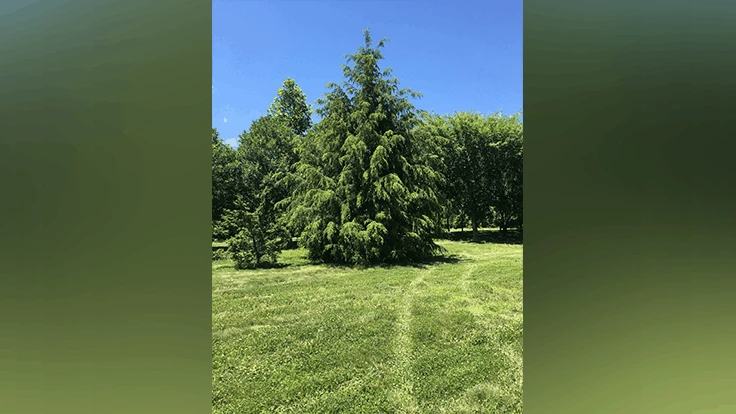
A hybrid hemlock, which is not vulnerable to the insect hemlock woolly
adelgid, has been developed by the Agricultural Research Service's (ARS) U.S.
National Arboretum. Traveler, as the new variety is named, is a cross between
the Chinese hemlock (Tsuga chinensis) and the native Carolina hemlock (Tsuga
caroliniana). The new tree has the native hemlock's handsome symmetrical
evergreen growth habit with slightly weeping branches It has a moderately slow
growth rate and produces large cones. But its most important characteristic is
the ability to survive attack from the hemlock woolly adelgid.
"We've had trials of Traveler growing since 2000, and we haven't seen
any damage from the insects despite the trees being planted out among
susceptible Carolina and eastern hemlocks," said ARS horticulturist Susan
Bentz. Bentz is with the U.S. National Arboretum's Floral and Nursery Plants
Research Unit in Beltsville, Maryland.
Sap-sucking hemlock woolly adelgids are closely related to the aphid.
Originally from Asia, the hemlock woolly adelgid arrived in the United States
in 1951 and has since spread to 17 states from Georgia to New England and
southwestern Nova Scotia, decimating stands of both Carolina and Eastern
hemlocks. The insect has virtually eliminated hemlocks as a marketable
ornamental tree in the eastern U.S. One reason for the insect's power to wipe
out large stands of hemlocks is its ability to reproduce parthenogenetically,
or without their eggs being fertilized.
This means female hemlock woolly adelgids can reproduce without males,
resulting in substantial annual population increases and decimation of large
stands of hemlocks. The Carolina hemlock's native range is basically parts of
the Appalachian Mountains in Georgia, South Carolina, North Carolina, Tennessee
and Virginia. More widespread, the eastern hemlock (Tsuga canadensis) is found
throughout New England, mid-Atlantic states and the Lake States and south into
the Appalachian Mountains in northern Georgia and Alabama and west from the
mountains into Indiana, western Ohio and western Kentucky.
While developing these hybrids, Bentz and colleagues found that the eastern
hemlock would not cross with the Chinese hemlock, while crosses between the
Carolina and Chinese hemlock produced several offspring that were verified
using molecular techniques. After promising replicated field and greenhouse
trials in Beltsville, MD, the researchers moved on to field trials of Traveler
and other similar crosses in North Carolina and Connecticut. "After 6
years in the North Carolina trial, the average height of Traveler trees planted
was 3.5 meters (11.5 feet) and all have survived," Bentz said. "It
will make a very attractive specimen tree in a large yard, park, commercial
site or as can informal large screen." Hemlocks play important roles in
forest ecosystems as well as in cultivated landscapes, serving as a
foundation of species that impacts hydrologic cycles, wildlife, and
biodiversity.
However, because Traveler is relatively slow growing and must be reproduced
asexually from cuttings, it will likely not be economically feasible to use
Traveler routinely in forest renovation. A plant patent has been applied for
Traveler, and ARS is looking for commercial propagation partners to help bring
this new plant to the nursery trade. The Agricultural Research Service is the
U.S. Department of Agriculture's chief scientific in-house research agency.
Daily, ARS focuses on solutions to agricultural problems affecting America.
Each dollar invested in agricultural research results in $20 of economic
impact.
Latest from Nursery Management
- Jackson & Perkins expands into Canadian market
- Green & Growin’ 26 brings together North Carolina’s green industry for education, connection and growth
- Marion Ag Service announces return of Doug Grott as chief operating officer
- The Garden Conservancy hosting Open Days 2026
- Registration open for 2026 Perennial Plant Association National Symposium
- Artificial intelligence applications and challenges
- Fred C. Gloeckner Foundation Research Fund calls for 2026 research proposals
- Harrell’s expands horticulture team with addition of Chad Keel