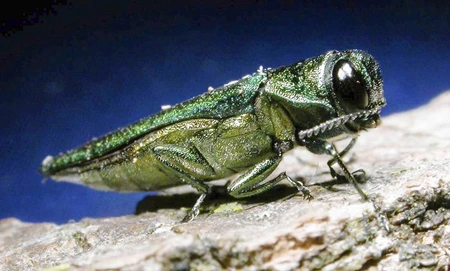
Emerald ash borers have already killed tens of millions of ash trees across the United States. The invasive species of beetle from Asia was introduced through wood packing material in 2002 in Michigan and through nursery trees a year later in Maryland.
If they're not stopped, the carnage will continue around the country and perhaps even in metropolitan Baltimore, where ash trees are the most common tree, frequently used for landscaping and fire wood, as well as tool handles, flooring and baseball bats.
"If these trees were all wiped out, it would be a huge problem ecologically," said Mickey Kopansky, a field technician with the Maryland Department of Agriculture who is working on eradication with other state workers and the U.S. Department of Agriculture's Animal and Plant Health Inspection Service.
Kopansky and Charles Pickett are two of about 21 state agriculture workers who have spent the past three weeks blanketing the state with glue-slathered purple traps made from two-foot long corrugated plastic, folded in a triangle and baited with Manuka oil from New Zealand. They drive around the region, stopping every few miles to hang a trap 20 feet to 60 feet up a tree.
The half-inch, bright green beetles will be hatching in about two weeks, and Kopansky will check the traps all summer for them.
Michael J. Raupp, a University of Maryland professor of entomology and an extension specialist who studies the ash borer, said the traps slow the spread to just under a mile a year. With no control, they would spread more like eight miles.
He predicts ash borers will make it into Washington next year. Baltimore could see decades at the mile-a-year rate, though Raupp said someone is likely to unwittingly transport infested wood before then.
The adults don't do much more than nibble on leaves, but the larvae burrow under the bark and wreak havoc. Infested trees become unable to transport nutrients and begin to wither from the top down.
The state has spent about $8.1 million since 2003 on prevention and containment, according to state agriculture department records. But the costs of an all-out infestation would be staggering, he said.
Photo courtesy of AP Photos
Latest from Nursery Management
- [SNEAK PEAK] Leading Women of Horticulture: Louise Schaefer and Susan Tantsits
- The Growth Industry Episode 10: State of the Horticulture Industry
- Tennessee Green Industry Field Day scheduled for June 11
- UTIA and UT Knoxville research teams will develop automated compost monitoring system
- Ken and Deena Altman receive American Floral Endowment Ambassador Award
- [SNEAK PEEK] Leading Women of Horticulture: Becky Thomas
- [SNEAK PEEK] Leading Women of Horticulture: Angela Burke
- [SNEAK PEEK] Leading Women of Horticulture: Alexa Patti