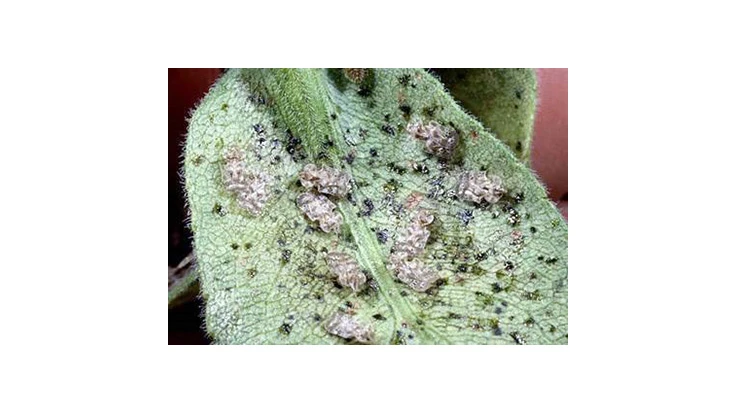
Lace bugs are insects in the order Hemiptera and the Tingidae family. Adult lace bugs range in size from about 3 to 6 millimeters (0.126-0.25 inch) long, and have a netlike pattern on the wings (Photo 1). The wings are also dotted with brown and black, which helps in identifying them using a hand lens. The nymphs, or immatures, are similar except they are smaller and often have spines. Lace bug eggs are relatively small and are easily distinguished, as they are elongated and cylindrical in shape. They kind of resemble small, black smoke stacks attached to the undersides of leaves.
When lace bugs develop on herbaceous perennial plants, the adults probably overwinter in a protective location like on the ground in leaf litter. They emerge as spring growth starts. Adult females attach their eggs to the undersides of the leaves, often along the mid-ribs, sometimes covering them with a black, varnish-like coating. The nymphs complete their life cycles quickly, and one to several generations can occur during the growing season; most often there are two generations. During a warm summer, lace bugs can complete a generation in as few as 30 days. Most often by the end of September, all life stages can be found on a host plant.
Click here to read more.
Latest from Nursery Management
- Jackson & Perkins expands into Canadian market
- Green & Growin’ 26 brings together North Carolina’s green industry for education, connection and growth
- Marion Ag Service announces return of Doug Grott as chief operating officer
- The Garden Conservancy hosting Open Days 2026
- Registration open for 2026 Perennial Plant Association National Symposium
- Artificial intelligence applications and challenges
- Fred C. Gloeckner Foundation Research Fund calls for 2026 research proposals
- Harrell’s expands horticulture team with addition of Chad Keel