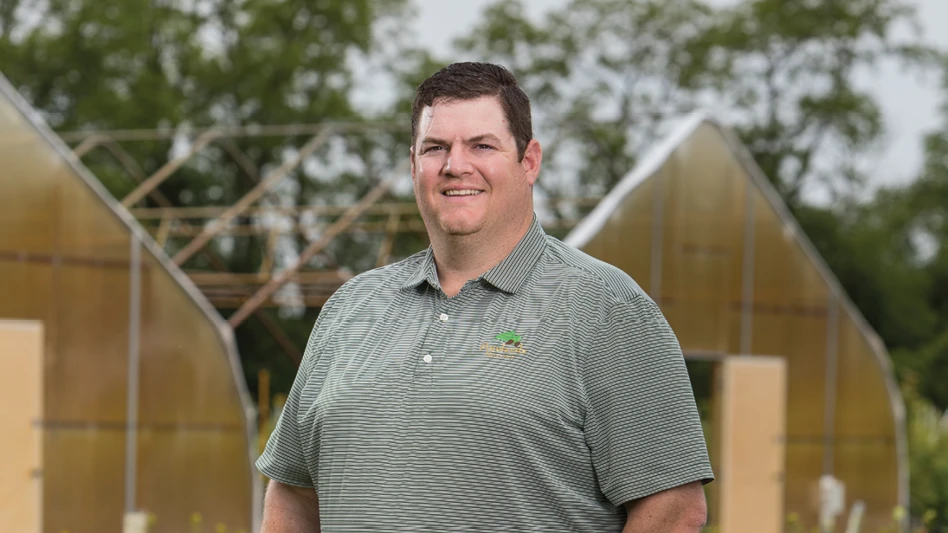
John Lewis, president of JLPN Liners, has implemented several Lean principles to make his operation more efficient. These changes clearly benefit his operation, his employees, and his product, but the changes also benefit his customers.
Nursery Management editor Kelli Rodda spoke to John about the process of implementing Lean and how it all boils down to a superior tree liner, providing growers with the ability to produce an excellent finished product.
Q: We’ve heard about some of the Lean principles you’ve implemented. (Read about it here.) How do you make sure these changes remain in place, and that crews don’t fall back on old ways and processes?
A: I would say that one of the biggest challenges is to make sure that the tool they need to do a process, is available, and in good working order. Say for instance we needed to grade a greenhouse, and they go to get the conveyor belt and it's missing, or a wheel has busted off, or the motor isn't working right. The Lean principle would be eliminating waste, but the failure in Lean practice would be not having the belt where it's supposed to be and not in proper working condition. Lean teaches us that the tool goes back where it can be found repeatedly, and that it will always be maintained for good working order. I would say the best way to keep these processes in place, and keep them continual, would be reinforcing the "why" we do Lean with the foreman and the entire crew. Also, once the crew gets the hang of Lean, they realize how easy a task becomes when they aren't running around looking for equipment or fixing it when they do find it.
Q: How have your employees reacted?
A: I would say that the employees have reacted well, because they see the amount of work we are able to get done. But the biggest reason is because Lean principles make work easier. Why hand carry heavy tree flats when they can be moved by belt or trailers? Lean practices make an environment better, safer, and efficient for the worker.
Q: How often do you review the new Lean principles?
A: We are constantly on the lookout for adding new Lean principles to what we do. In general, we try to analyze a process before we actually get going with it, anywhere from a couple months to a full year ahead of time. That gives us time to set up and implement changes to the process before we start. In doing so, we avoid designing waste into our processes.
Q: The benefits of Lean are many when it comes to your company, but how does your implementation of Lean principles help your customers?
A: First, when I see a company that invests money in Lean principles, that tells me many things about them. First, they are willing to invest in a better work environment for the workers, which shows a dedication to long-term vision in the industry. Second, if a company cares that much about investing into principles and practices of processing and production, they obviously put a lot of care into creating the best product on the market. That delivers value to the customer. Lastly, customers can be assured that a company that practices and employs Lean is not only a good grower, but a direct reflection of the company's solid business practices. That translates to customers knowing that JLPN is going to be able to answer the call to production when customers need a supplier that they can rely on consistently to produce more product with fewer defects and on a reliable basis. We will always be able to say "yes" when growers need more product.
Q: Are you sharing the Lean message with your customers? How?
A: I am sharing the Lean message with my customers now, and we always have. There are two topics in every nursery conversation right now. Labor and inventory. Lean practices that we've employed have decreased our dependency on a high volume of labor. Our labor needs are still great, but much less than before. Having Lean practices in place has allowed us to create more product with less staff.
Q: What type of feedback are you getting from customers?
A: We typically hear, "Wow!" Comments like, "I had no idea how much you guys have going on out here," or "I had no idea how much product you are producing." A catalog and a website can never fully show the size, speed and scale of an operation, until you have your boots on the nursery. I have generated a lot of enthusiasm for our growers and some possible relief to production woes. When we are able to walk our nursery and our growers' nurseries, we get feedback and we can brainstorm and conceptualize processes. We have several that we are working on currently to help our customers speed up some of their processes with fewer people needed. It's made business fun in a whole different way.
For more: jlpnliners.com
Latest from Nursery Management
- [SNEAK PEAK] Leading Women of Horticulture: Louise Schaefer and Susan Tantsits
- The Growth Industry Episode 10: State of the Horticulture Industry
- Tennessee Green Industry Field Day scheduled for June 11
- UTIA and UT Knoxville research teams will develop automated compost monitoring system
- Ken and Deena Altman receive American Floral Endowment Ambassador Award
- [SNEAK PEEK] Leading Women of Horticulture: Becky Thomas
- [SNEAK PEEK] Leading Women of Horticulture: Angela Burke
- [SNEAK PEEK] Leading Women of Horticulture: Alexa Patti