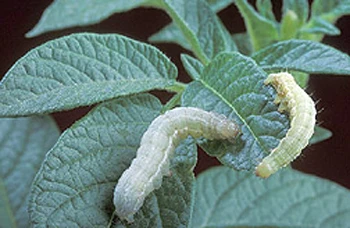
Scientists with the USDA-Agricultural Research Service are developing an environmentally friendly bacteria-based biocontrol agent that offers long-lasting protection against caterpillars and other pests. This biocontrol agent would have application to both commercial crop production and home garden use.
Bacillus thuringiensis (Bt) is now used to control gypsy moths, tent caterpillars, leaf rollers, canker worms and other pests of ornamental and agricultural crops. The commonly used strain, B. thuringiensis kurstaki, doesn’t survive more than one generation. Once the pest is killed, the biocontrol dies out and the pests return.
Scientists at the Invasive Insect Biocontrol and Behavior Laboratory in Beltsville, Md., looked at survival rates of the bacteria over several generations of caterpillars and found that urease-producing phenotypes survived better when repeatedly fed to gypsy moths. Of 26 urease-producing Bt strains, 23 survived five passages through gypsy moth larvae, while none of the 24 strains that don’t produce urease survived them.
The results, published in Biological Control, bring scientists a step closer to finding a Bt strain that is more effective at combating gypsy moths and possibly other insect pests. The efforts should also lead to the development of Bt strains with other desirable traits, including being able to multiply on specific crops, or thrive in commercials settings and gardens favored by a targeted pest.
Pictured: USDA-Agricultural Research Service scientists are working to develop an environmentally friendly Bacillus thuringiensis (Bt) strain that offers long-lasting protection against caterpillars and other pests.
Photo by Peggy Greb
Latest from Nursery Management
- [SNEAK PEAK] Leading Women of Horticulture: Louise Schaefer and Susan Tantsits
- The Growth Industry Episode 10: State of the Horticulture Industry
- Tennessee Green Industry Field Day scheduled for June 11
- UTIA and UT Knoxville research teams will develop automated compost monitoring system
- Ken and Deena Altman receive American Floral Endowment Ambassador Award
- [SNEAK PEEK] Leading Women of Horticulture: Becky Thomas
- [SNEAK PEEK] Leading Women of Horticulture: Angela Burke
- [SNEAK PEEK] Leading Women of Horticulture: Alexa Patti