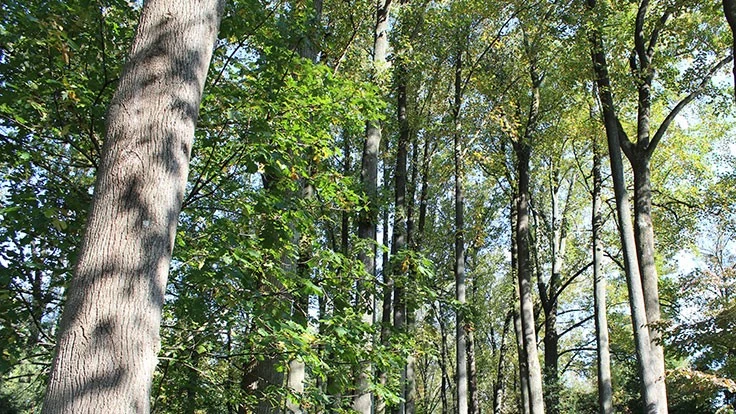
For a decade, researchers explored how tree species diversity affects the coexistence of trees and their growth performance in the largest biodiversity experiment with trees worldwide, the so-called 'BEF-China' experiment.
The study was performed by ecologists from TU Dresden in cooperation with the Leuphana University Lüneburg, the Martin-Luther-University Halle-Wittenberg, the Beijing Forestry University and the German Centre for integrative Biodiversity Research.
One of the main interests of the BEF-China team is to explore the relationship between tree diversity and multiple ecosystem functions, specifically those benefiting society, such as wood production or the mitigation of soil erosion.
For this purpose, an experimental site of c. 50 hectare in subtropical China was planted with more than 400,000 trees and shrubs. Trees have achieved a height of 10 to 15 m and their crowns have formed a dense canopy by that time.
The findings now shed new light on tree-tree interactions: The local environment of a tree strongly determine its productivity, meaning that tree individuals growing in a species-rich neighborhood produce more wood than those surrounded by neighbors of the same species. "Particularly impressive is the finding that the interrelations of a tree with its immediate neighbors induce higher productivity of the entire tree community (i.e. the forest stand), and that such local neighborhood interactions explain more than 50 percent of the total forest stand productivity," says forest ecologist Dr. Andreas Fichtner.
Click here to read more, or read the researchers' full article in Nature Communications.
Latest from Nursery Management
- [SNEAK PEAK] Leading Women of Horticulture: Louise Schaefer and Susan Tantsits
- The Growth Industry Episode 10: State of the Horticulture Industry
- Tennessee Green Industry Field Day scheduled for June 11
- UTIA and UT Knoxville research teams will develop automated compost monitoring system
- Ken and Deena Altman receive American Floral Endowment Ambassador Award
- [SNEAK PEEK] Leading Women of Horticulture: Becky Thomas
- [SNEAK PEEK] Leading Women of Horticulture: Angela Burke
- [SNEAK PEEK] Leading Women of Horticulture: Alexa Patti