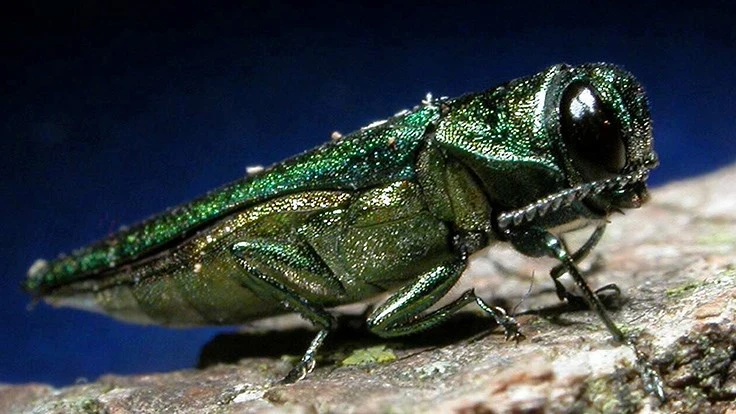
Since its discovery in the United States in 2002, the emerald ash borer has swiftly become the most destructive non-native forest pest to ever invade the country. As the insect’s range continues to grow, despite ongoing efforts to fight it, communities with ash trees in both urban areas and woodlands are left to pick up the pieces.
Despite the seemingly grim outlook, hope is not lost. In Pennsylvania, where emerald ash borer (Agrilus planipennis) has been present since 2007, municipalities have found successful ash-management plans under guidance of the state’s Department of Conservation and Natural Resources, and they offer a model for other regions to follow. In a new guide published in open-access Journal of Integrated Pest Management, Houping Liu, Ph.D., forest entomologist at the Pennsylvania DCNR, outlines a set of four options for communities to choose from as they plan for the impact of the emerald ash borer:
- No action costs nothing up front, but a community is most likely to be burdened with the cost of hazard-tree removal and replanting afterward.
- Selective management involves moderate costs for the protection of some high-value ash trees in a community and is complemented by limited tree removal and replacement.
- Preemptive management costs the most up front by eliminating risk from emerald ash borer through complete tree removal before they become infested.
- Aggressive management costs more over time, with the least negative social and environmental impact from emerald ash borer infestation.
Click here to read more from Entomology Today.
Photo: David Cappaert, Bugwood.org
Latest from Nursery Management
- [SNEAK PEAK] Leading Women of Horticulture: Louise Schaefer and Susan Tantsits
- The Growth Industry Episode 10: State of the Horticulture Industry
- Tennessee Green Industry Field Day scheduled for June 11
- UTIA and UT Knoxville research teams will develop automated compost monitoring system
- Ken and Deena Altman receive American Floral Endowment Ambassador Award
- [SNEAK PEEK] Leading Women of Horticulture: Becky Thomas
- [SNEAK PEEK] Leading Women of Horticulture: Angela Burke
- [SNEAK PEEK] Leading Women of Horticulture: Alexa Patti