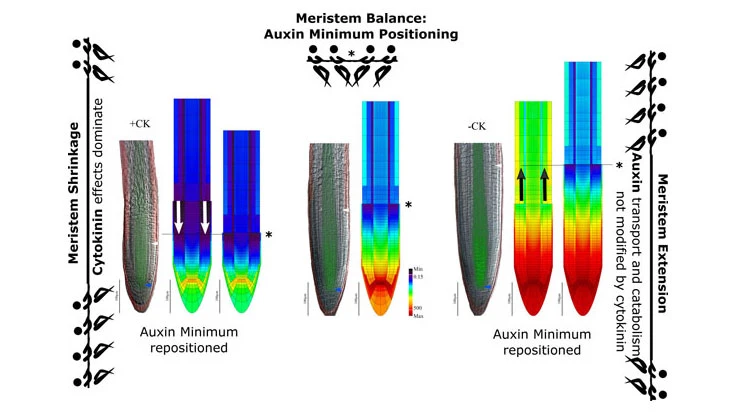
A sophisticated mechanism that allows plant roots to quickly respond to changes in soil conditions has been identified by an international research team.
Scientists from the John Innes Centre and Sapienza University, Rome, combined mathematical and computer modelling with molecular genetics to show how roots can regulate their growth via the interactions of two antagonistic hormones, auxin and cytokinin.
As the root grows and meristem cells at the tip continuously divide, they are left behind in relation to the moving root tip. When these cells reach a certain distance from the tip, called the transition position, they stop dividing and instead start elongating until reaching their maximum lengths.
Photo from the John Innes Centre.
Latest from Nursery Management
- [SNEAK PEAK] Leading Women of Horticulture: Louise Schaefer and Susan Tantsits
- The Growth Industry Episode 10: State of the Horticulture Industry
- Tennessee Green Industry Field Day scheduled for June 11
- UTIA and UT Knoxville research teams will develop automated compost monitoring system
- Ken and Deena Altman receive American Floral Endowment Ambassador Award
- [SNEAK PEEK] Leading Women of Horticulture: Becky Thomas
- [SNEAK PEEK] Leading Women of Horticulture: Angela Burke
- [SNEAK PEEK] Leading Women of Horticulture: Alexa Patti