New research into how a plant virus assembles could lay the groundwork for future use to carry drugs into the human body.
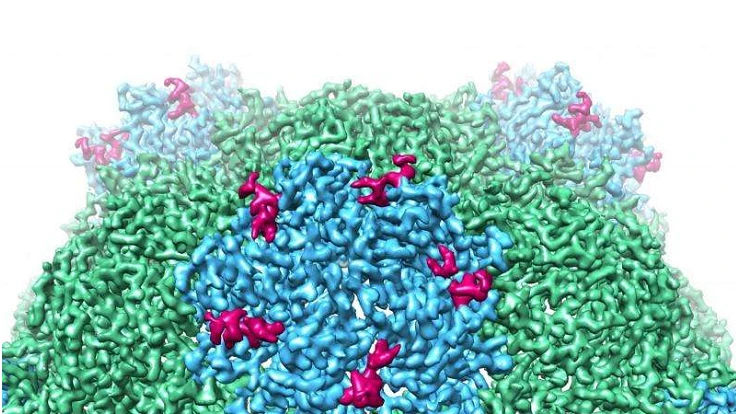
The study, by a team from the University of Leeds' Astbury Centre for Structural Molecular Biology and the John Innes Centre in Norwich, describes the structure of an empty version of Cowpea Mosaic Virus (CPMV) and the molecular 'glue' that allows the virus to build itself and encapsulate its genome.
The findings, published in the journal Nature Communications and based on revolutionary new electron microscopy, may be a crucial step to eventually allowing scientists to build custom versions of the virus that can carry medicines into the body and target disease.
Lead author Dr Neil Ranson, Associate Professor of Structural Molecular Biology at the University of Leeds, said: "To use Cowpea Mosaic Virus as a drug delivery vehicle, we need to understand how it puts itself together, and to do that we need to understand its structure in solution in very fine detail.
"Just a couple of years ago, that was impossible because we simply couldn't see complex biological systems in the detail required. A new generation of electron microscopes, however, is revolutionizing our ability to peer into the virus' inner workings and understand how we might make it work for us."
Click here to read more.
Latest from Nursery Management
- [SNEAK PEAK] Leading Women of Horticulture: Louise Schaefer and Susan Tantsits
- The Growth Industry Episode 10: State of the Horticulture Industry
- Tennessee Green Industry Field Day scheduled for June 11
- UTIA and UT Knoxville research teams will develop automated compost monitoring system
- Ken and Deena Altman receive American Floral Endowment Ambassador Award
- [SNEAK PEEK] Leading Women of Horticulture: Becky Thomas
- [SNEAK PEEK] Leading Women of Horticulture: Angela Burke
- [SNEAK PEEK] Leading Women of Horticulture: Alexa Patti