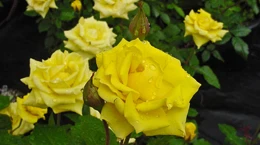
Grandma's Yellow rose is the newest Texas Superstar selection, one of five that will be announced for 2010, said Dr. Larry Stein, AgriLife Extension horticulturist and one of the developers of Grandma's Yellow rose.
AgriLife Extension and Texas AgriLife Researchers extensively test and designate plants as Texas Superstars that are not just beautiful but perform well for Texas consumers and growers.
Stein and his fellow horticulturists named the new Texas Superstar in honor of Stein's grandmother, Tillie Jungman, who loved the yellow rose and helped grow test varieties in her garden near Castroville, Stein said.
Stein noted the name 'Grandma' has other connotations in addition to his grandmother helping test the plant. The new Texas Superstar is tough yet beautiful, self-sufficient on its own root stock, and low-maintenance, requiring little intervention except some occasional tender loving care. Which is a lot like how his grandmother Tillie was, Stein said.
"This is a rose which does not need constant spraying to survive and produce lovely yellow Valentine-like blooms," Stein said. "It produces successive flushes of blooms -- from spring until frost -- and is so disease tolerant that fungicide sprays are seldom required. However in wet, high-pressure disease years, fungicide sprays will be needed to keep black spot in check. It is an outstanding performer even in highly alkaline clay soils."
And though it has a lot in common with antique roses, including growing on its own root stock, Grandma's Yellow rose produces large, modern "Valentine's Day" blooms. And like most people's grandmothers, the rose has a rich, interesting history.
"Valentine's Day" bloom is a rosarian term for long-stemmed, cutting roses, typical of the type favored as Valentine's Day gifts, Stein said.
A team composed of Stein; Jerry Parsons, retired professor and AgriLife Extension horticulturist; and Greg Grant, horticulturist with Stephen F. Austin State University and former AgriLife Extension horticulturist in Bexar County, began looking for a better yellow rose in 1996. In addition to aesthetic value and good performance, they wanted a plant that was both easy to take care of and to root and otherwise propagate.
"There are a lot of yellow roses on the market, but most you have to spray every week or so to really make them do well," he said. "One of the main elements of being made a Texas SuperStar is it must be able to be propagated and mass-produced in sufficient numbers to meet the increased consumer demand generated." Grandma’s Yellow is readily propagated.
More information on the history and characteristics of Grandma's Yellow rose can be found here. Texas Superstar is a registered trademark owned by Texas AgriLife Research.
Latest from Nursery Management
- Jackson & Perkins expands into Canadian market
- Green & Growin’ 26 brings together North Carolina’s green industry for education, connection and growth
- Marion Ag Service announces return of Doug Grott as chief operating officer
- The Garden Conservancy hosting Open Days 2026
- Registration open for 2026 Perennial Plant Association National Symposium
- Artificial intelligence applications and challenges
- Fred C. Gloeckner Foundation Research Fund calls for 2026 research proposals
- Harrell’s expands horticulture team with addition of Chad Keel