From Michigan State University Extension:
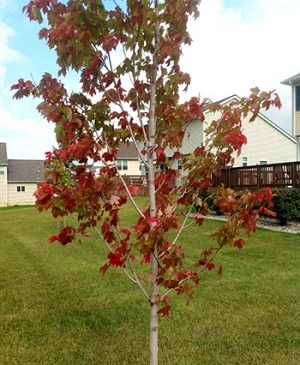
A red maple sample was brought into a Michigan State University Extension office in southern Michigan. The leaves were smaller than normal and had a beautiful shade of red along the edges. The red color is what we expect to see in autumn across Michigan, but this tree started to turn colors back in early August. Though beautiful in October, early fall color in landscape plants can be an indicator of a stressed plant. Your plants could be letting you know they are having problems and may need help.
Burning bushes can turn color and drop leaves early when infested with spider mites. This commonly occurs when plants are growing in a location near a wall, sidewalk or driveway where reflected heat can cause stress. Heat-stressed burning bushes and other plants like Alberta spruces are prime locations for the buildup of mite populations that develop quickly under hot conditions causing injured foliage that turns color and drops early.
Damage to the base of a trunk or stem from animal feeding, weed whips, mowers and disease will reduce the flow of water and nutrients up a tree, leaving the plant weak and susceptible to other problems. This type of damage stresses the tree much like drought stress. Trees and shrubs weakened from these injuries may turn color early. Plants with damaged stems may need watering during dry conditions to prevent further damage.
The red maple brought into the MSU Extension office was not injured by a pest, disease or by mechanical equipment. It was injured during the drought of summer 2012 which showed greatly reduced growth the following spring. Drought-injured plants may not fully recover for a few years and, if weak to begin with, they may not recover. Often this type of stress is evident in reduced growth of the branches, small leaves and early fall color.
Click here to read more:
Latest from Nursery Management
- [SNEAK PEAK] Leading Women of Horticulture: Louise Schaefer and Susan Tantsits
- The Growth Industry Episode 10: State of the Horticulture Industry
- Tennessee Green Industry Field Day scheduled for June 11
- UTIA and UT Knoxville research teams will develop automated compost monitoring system
- Ken and Deena Altman receive American Floral Endowment Ambassador Award
- [SNEAK PEEK] Leading Women of Horticulture: Becky Thomas
- [SNEAK PEEK] Leading Women of Horticulture: Angela Burke
- [SNEAK PEEK] Leading Women of Horticulture: Alexa Patti