DES MOINES – The emerald ash borer (EAB), a highly destructive insect of ash trees, has been confirmed in Dubuque, Iowa. Twenty-eight of Iowa’s counties have now been confirmed positive. Since its initial discovery in Michigan in 2002, this exotic pest has spread to 25 states killing tens of millions of trees.
In addition to the southern Dubuque detection, a tree in a rural area just outside south Dubuque city limits was also detected. Both sites were declared positive after the collection of EAB larvae.
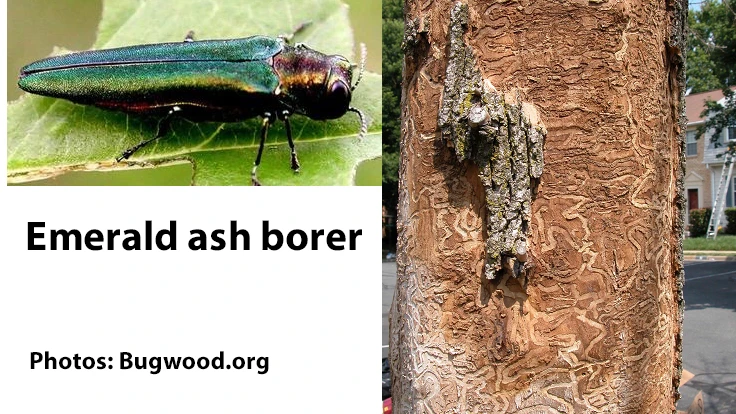
EAB is a small, metallic-green beetle that is about ½ inch long. The larvae chew into the layer of wood under the bark, cutting off the flow of water and nutrients. EAB infested ash trees include thinning or dying branches in the top of a tree, evidence of woodpecker activity, S-shaped feeding galleries under dead or splitting bark, D-shaped exit holes, and water sprouts (along the trunk and main branches).
“Iowa now has seven counties bordering the Mississippi River that have turned up positive for EAB,” said Mike Kintner, Iowa Department of Agriculture and Land Stewardship EAB and gypsy moth coordinator. “Unfortunate as it is, I wouldn’t be surprised to see the remaining three counties declared positive within a year.”
The Iowa EAB Team provides EAB diagnostic assistance to landowners and includes officials from Iowa Department of Agriculture and Land Stewardship, Iowa State University Extension and Outreach, the Iowa Department of Natural Resources, USDA Animal Plant Health Inspection Service and the USDA Forest Service.
Since larvae of EAB can unknowingly be transported under the bark of a tree, the Iowa EAB Team strongly cautions Iowans not to transport firewood across county or state lines. The movement of firewood throughout Iowa or to other states poses the greatest threat to quickly spread EAB and other plant pests. A statewide quarantine remains in place, restricting the movement of hardwood firewood, ash logs, wood chips and ash tree nursery stock out of Iowa into non-quarantined areas of other states.
To learn more about EAB and other pests that are threatening Iowa’s tree population, please visit www.IowaTreePests.com.
For contact information to reach a member of Iowa's EAB team, click here.
Latest from Nursery Management
- [SNEAK PEEK] Leading Women of Horticulture: Angela Burke
- Get to know Hailey Clark
- Get to know Brian Kemble
- Proven Winners partners with Pure Line Seeds to offer vegetable plants
- Award winners announced for 2026 PHS Philadelphia Flower Show
- Kansas City botanical garden Powell Gardens acquires IGC Colonial Gardens
- [SNEAK PEEK] Leading Women of Horticulture: Delilah Onofrey and Krystal Snyder
- [SNEAK PEEK] Leading Women of Horticulture: Alexa Patti