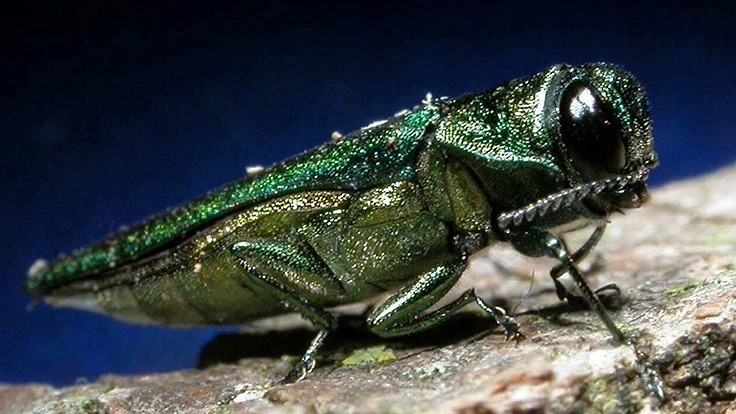
SUPERIOR, Colo. – June 26, 2018 – State officials have confirmed the presence of emerald ash borer (EAB) – an invasive, highly destructive tree pest – in the Town of Superior in southeast Boulder County. This new detection is still just within a quarantine area established to try and prevent the human assisted spread of EAB. However, it represents the fifth community with confirmation of EAB in Colorado outside the City of Boulder, where the pest was first detected in 2013.
An estimated 15 percent or more of all urban and community trees in Colorado are ash species susceptible to being killed by EAB – and a majority of these trees are on private land. EAB attacks and kills both stressed and healthy ash trees and is so aggressive that trees typically die within two to four years after becoming infested.
Boulder County foresters recently identified a dead adult EAB on a trap the county had previously set – along with a dozen others in targeted areas – to detect for early infestation of the pest. This particular trap was located on public property along the Mayhoffer Singletree Trail, near the intersection of West Thomas and Third Avenue in Superior. The foresters presented the adult beetle specimen to Colorado State University experts, who have now confirmed the insect as being EAB. Since then, EAB symptoms have been confirmed in multiple nearby ash trees on private property, as experts from the interagency Colorado EAB Response Team – a group working to manage the spread and impacts of the pest – helps to assess the observable extent of EAB in the area.
Over the past four years the Colorado State Forest Service, partnering with Boulder County and the City of Boulder, has set hundreds of traps targeting EAB to try and detect its presence along roadways within Boulder County. Many Front Range municipalities also have set traps to try and potentially detect EAB as soon as possible after its arrival. The traps are designed as detection tools that lure in EAB adults using attractant odors and color schemes, and are coated in a sticky substance to capture individuals that come into contact with them.
It is unknown whether EAB arrived in Superior by natural spread or via accidental human transport, such as in firewood or other raw ash material. Populations of the insect are capable of spreading a half-mile each year on their own, and Superior is not far from other EAB detections in Lafayette and Boulder. Many Front Range communities are managing for EAB before its arrival, including the Town of Superior. Its Parks, Recreation and Open Space Department has begun removing and replacing smaller, less healthy public ash trees, and has been treating more valuable, targeted trees to protect them from EAB. The town will not be treating private ash trees and recommends that residents take action now to assess and evaluate management of those trees.
EAB was first confirmed in Colorado in September 2013, in the City of Boulder. Since then, the pest has been confirmed in Gunbarrel, Longmont, Lafayette and Lyons – all within Boulder County and an established EAB Quarantine area. At this time, EAB has not been detected in Colorado outside the county or quarantine. However, the pest is extremely difficult to detect when its numbers are low in an area.
For more information, visit www.eabcolorado.com.
Photo: David Cappaert, Bugwood.org
Latest from Nursery Management
- [SNEAK PEAK] Leading Women of Horticulture: Louise Schaefer and Susan Tantsits
- The Growth Industry podcast Episode 10: State of the Horticulture Industry
- Tennessee Green Industry Field Day scheduled for June 11
- UTIA and UT Knoxville research teams will develop automated compost monitoring system
- Ken and Deena Altman receive American Floral Endowment Ambassador Award
- [SNEAK PEEK] Leading Women of Horticulture: Becky Thomas
- [WATCH] Taking root: The green industry’s guide to successful internships
- [SNEAK PEEK] Leading Women of Horticulture: Angela Burke