Butterfly bushes are taking over the world. A July 2011 garden visit to England provided the impetus to cobble this story together. Buddleia davidii seedlings, primarily lavender, are in abundance in the chalky (limestone) soils in the south of England, particularly Hampshire, where Bonnie and I spent most of our vacation.
A daily walk along the Test Way had us in the shadows of 15-foot high Buddleia. A visit to the national Buddleia collection at Longstock Park, just north of Stockbridge, prompted the question . . . Does the world need another Buddleia? Apparently, the answer is yes, for Peter Moore, plant breeder extraordinaire and curator of the collection. He is currently expanding the planting area and has added many of the newer introductions including Denny Werner’s ‘Miss Molly,’ ‘Miss Ruby,’ ‘Blue Chip,’ the Buzz series and many others. I commented about a deep saturated blue, ‘Griffin Blue,’ with 12-inch long panicles growing in the collection. I mentioned to Peter that I found it as a self-sown seedling in Griffin, Ga. He said it really was not that impressive.
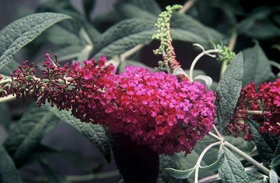
So much for Georgia’s contributions to breeding Buddleia. In the late ‘90s, early 2000, butterfly bush improvement was an active pursuit. At the time, ‘Attraction’ (red-purple), ‘Bicolor’ (lavender-purple with butterscotch eye), ‘Bonnie’ (lavender with orange eye), ‘Griffin Blue’ (blue), ‘Guinevere’ (deep purple), ‘Honeycomb’ (yellow), ‘Silver Frost’ (white), ‘Violet Eyes’ (dusty violet), ‘Lavender Eyes,’ ‘Raspberry Eyes,’ and ‘White Eyes’ were introduced with ‘Attraction.’ Werner used ‘Attraction’ in breeding ‘Miss Molly’ and ‘Miss Ruby.’ ‘Bicolor’ with the butterscotch eye and lavender-purple outer corolla attracted commercial growers. In fact, according to Moore, the latter was renamed by the Dutch as ‘Flowerpower.’
Jeff Gillman, now at the University of Minnesota, worked on mite resistance in Buddleia, utilizing the Georgia collection. When Gillman graduated and the market appeared flooded with introductions, the program was dismantled. Did the world want another Buddleia? Not at that time, but things change.
Leading breeders
Jon Lindstrom at the University of Arkansas; Werner at North Carolina State University; Peter Podaras from the Landscape Plant Development Center (and formerly with Cornell); Thompson and Morgan’s Buzz Series; Elizabeth Keep of the East Malling Research Station in Kent, England; and the aforementioned Peter Moore, have contributed mightily to Buddleia improvement. Before these breeders, most introductions were chance seedlings, open-pollinated (mother known, father carried on the wind) and branch sports, primarily variegated like ‘Harlequin,’ ‘Santana,’ ‘Evil Ways,’ Strawberry Lemonade (‘Monrell’). Genetic plasticity in Buddleia davidii is enormous and an open-pollinated seedling population will yield significant variation, most of it worthless. Anyone with the itch to breed Buddleia should assess Longstock’s collection and consult the 2008-2010 trials report, Buddleia davidii and its close hybrids, at www.rhs.org.uk.
The future of the genus: A true red-flowered introduction, compact types like ‘Blue Chip’ with unique flower colors and larger inflorescences, silver-gray or evergreen foliage, self-cleaning (i.e., flowers abscise), double flowers (observed such a selection), multi-colored inflorescences (again observed such), mite resistance and sterility (have this in newer hybrids).
At the Center for Applied Nursery Research (CANR) at McCorkle Nurseries in Dearing, Ga., thousands of seedlings were evaluated. All flowered in the first growing season, a trait that contributes to the ease of selection. The capsular fruit dehisces in mid- to late fall and on windy days, seeds float on the currents, akin to pine pollen in spring. Collect seed, sow, up it comes, transplant to 2-gallon container and 10-12 weeks later flowers are abundant. Select a great one, vegetatively propagate, evaluate for habit, size, rebloom, sterility and by year two, the itch/impulse to name is mighty. Practice patience . . .
Unless, of course, Doug Welty, the specialty marketing manager at QVC visits (as he did Plant Introductions in 2010) and requests in five colors, 50,000 of each for an offering on QVC. I told Welty that UGA released 11 with a broad color range. He wanted new and went with the Buzz series, selling 250,000 in 2011. So much for “Who cares about Buddleia?” Time for Plant Introductions Inc. to start breeding.
Exciting releases
In the plant breeding business, general familiarity by the gardening public with certain plant names is helpful. Hydrangea, crapemyrtle, azalea, butterfly bush, etc., are recognizable names, often associated with a grandmother’s garden, and ones that retailers do not have to educate consumers about. Denny Werner’s ‘Miss Ruby’ then ‘Miss Molly’ and Peter Moore’s ‘Sugar Plum’ have excited gardeners. The Royal Horticultural Society, Wisley, granted an Award of Garden Merit to ‘Miss Ruby’ in 2011. In its butterfly trials it was the most highly rated cultivar by the visiting public, outdistancing some 70 others. On our trip to England, ‘Miss Ruby’ was already available in several garden centers. It was released by NCSU in 2007.
Based on the successes of the new introductions, I believe (actually know) that the Buddleia cupboard will be full to overflowing far into the future. Allow me to discuss the wave of new observations based on the literature and correspondence with the breeders. I have not observed all, but enough from each breeder/series to provide modulated guidance. Possibly the over-arching error is the release of too many in a given series. The Flutterby series from Peter Podaras and Ball Ornamentals Inc. includes 15 selections. Growers and gardeners deserve the best, so as breeders we should deliver on that promise. With about 100 species of Buddleia, opportunities for unique combinations abound. The newer cultivars are of mixed species’ parentage and not simply derived from the Buddleia davidii gene pool.
Read more here: http://www.nurserymanagementonline.com/nm0912-buddleia-butterfly-bushes.aspx
Latest from Nursery Management
- Jackson & Perkins expands into Canadian market
- Green & Growin’ 26 brings together North Carolina’s green industry for education, connection and growth
- Marion Ag Service announces return of Doug Grott as chief operating officer
- The Garden Conservancy hosting Open Days 2026
- Registration open for 2026 Perennial Plant Association National Symposium
- Artificial intelligence applications and challenges
- Fred C. Gloeckner Foundation Research Fund calls for 2026 research proposals
- Harrell’s expands horticulture team with addition of Chad Keel