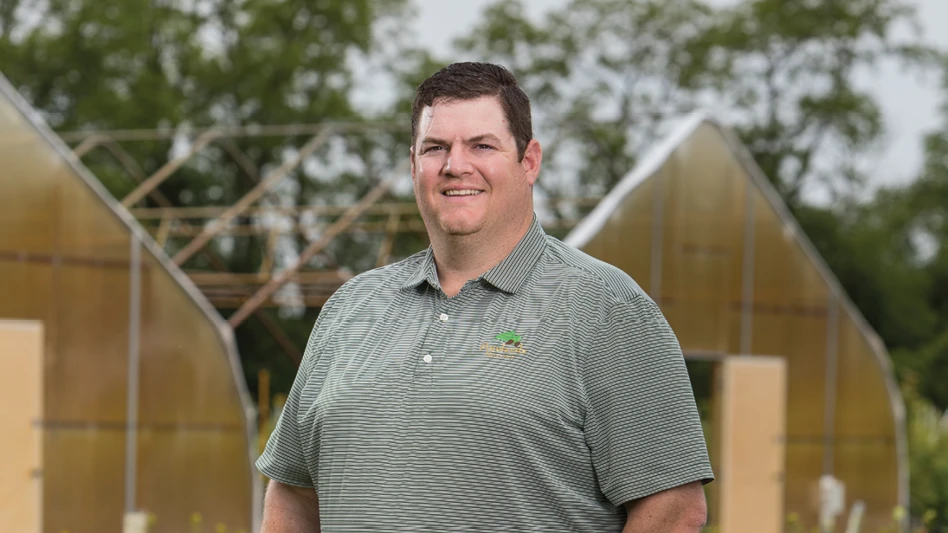
Larry Reddmann takes customer service seriously. It’s not an empty promise or a catch phrase on a poster. It’s the foundation of his Arkansas tree nursery. The Reddmanns grow 2- to 4-inch-caliper, balled-and-burlapped deciduous shade and ornamental trees.
Reddmann founded the nursery division of Lawrence Reddmann Farms with his son Greg in 2001. It was a new venture in a long line of family farming. But the goal of doing business with integrity was something he learned from three previous generations.
“I’m proud of the fact that we have an absolute commitment to pleasing the customer at any cost,” Larry said. “We follow up every load by asking the customer if everything is the way they wanted it to be. If the answer is ‘No,’ our immediate reply is, ‘What can we do about it?’ and we do it.”
The nursery pledges to work nights and weekends when a customer needs trees on short notice.
Reddmann also emulated some customer service techniques from a huge conglomerate.
“If we’re not already committed to someone else and it’s within 12 hours’ driving time, and a customer calls us by 7 a.m., we’ll have their order to them by 7 a.m. the next day -- just like FedEx.”
Summer digging
Larry’s commitment to the customer prompted him to start a summer digging program. Very few nurseries in the area were providing that service.
Trees slated for summer digging are presoaked for two days with plain water. If several trees will be dug, the nursery uses the drip-irrigation system to soak them. If only a handful will be dug, Larry and his crew tie a 65-gallon garbage bag around the tree, fill it with water and puncture a pinhole in the bag. It takes about 24 hours for the water to soak the tree, Larry said.
Trees are dug with a Red Boss tree spade on a Gehl skid steer. Once trees are dug, they’re moved to the shade and misted within two hours of digging.
“We will mist the trees until they leave us, which is within the week,” he said.
The nursery charges 15 percent extra for summer digging.
Red maples, red oaks and birch do well for summer digging, but not willow oak or white oak, he said.
Row crop influence
Larry’s great-grandfather founded the Reddmann farming operation in Arkansas in 1890. He cleared a small plot and started raising cattle.
“My grandfather was one of the first to raise rice in Arkansas in 1904. My father added soybeans to the operation in the early 1950s,” he said.
The nursery takes cues from some other farming techniques.
“Coming from a row crop background, we have planted our trees much the same way -- long rows with a gap of 100 feet every 50 trees to use as a road,” he said. “This makes mowing and spraying much faster because of less turning and less idle ground. This also allows us to use an airplane to spray for some types of insects and disease.”
Trellis protection
The nursery uses a trellis system when it lines out trees.
“We drive a T-post in the ground every 10 trees and stretch a rope between them,” he said. “We then use a piece of pipe-insulating foam to protect the tree when we tie it to the rope. We never need to return to these trees after a wind and rain to re-walk them in.”
{sidebar id=2}
Rows alternate between 12 feet wide and 9 feet wide, and trees are spaced 6 feet apart.
“Being relatively new to the nursery business, I see everything as a learning experience, and I find that very invigorating,” he said.
For more:
Founded: In 2001 by Larry and Greg Reddmann.
Location:
Crops: B&B shade and ornamental trees.
Production space: 200 acres.
Market: Landscape contractors and rewholesalers east of the
Employees: 12 at peak.
- Kelli Rodda
May 2008
Latest from Nursery Management
- [SNEAK PEAK] Leading Women of Horticulture: Louise Schaefer and Susan Tantsits
- The Growth Industry Episode 10: State of the Horticulture Industry
- Tennessee Green Industry Field Day scheduled for June 11
- UTIA and UT Knoxville research teams will develop automated compost monitoring system
- Ken and Deena Altman receive American Floral Endowment Ambassador Award
- [SNEAK PEEK] Leading Women of Horticulture: Becky Thomas
- [SNEAK PEEK] Leading Women of Horticulture: Angela Burke
- [SNEAK PEEK] Leading Women of Horticulture: Alexa Patti