Matt McClellan
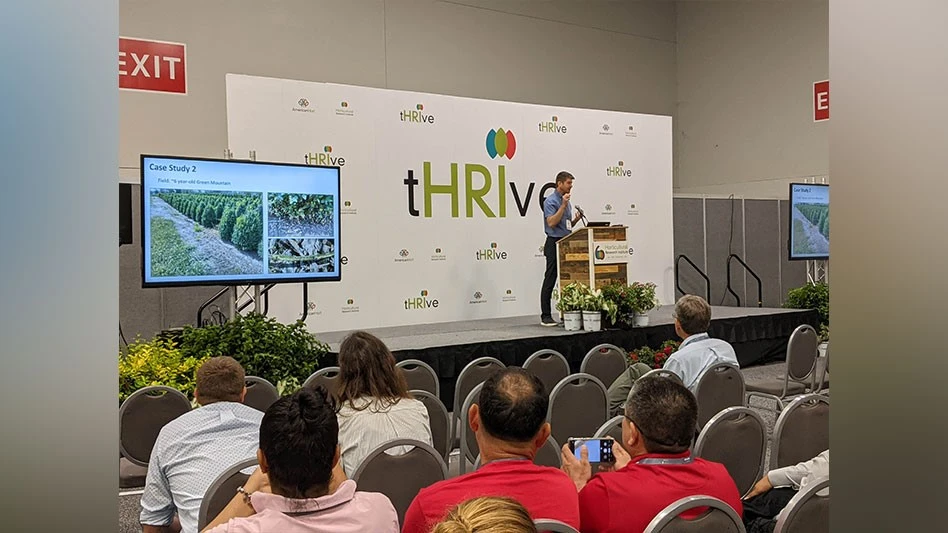
As part of the Boxwood Blight Insight Group, Jerry Weiland, USDA-ARS Research Plant Pathologist and Fulya Baysal-Gurel, associate professor at Tennessee State University, spoke to attendees at Cultivate'22 in Columbus, Ohio.
Weiland covered his observations about boxwood blight in the nursery industry. Over the last three years, Weiland and his team have surveyed over 7 million boxwood plants at 19 nurseries for boxwood blight. A number of trends have emerged that can help growers better understand this disease. In his session, Weiland covered how various production practices (cultivar choice, plant spacing, etc.) influence the frequency and severity of boxwood blight in propagation, container, and field nursery systems.
During his talk, Weiland gave several recommendations for nurseries that do not currently have boxwood blight on their premises, and also recommendations for nurseries that do have a current boxwood blight infection.
If your nursery has a boxwood blight problem, he offers these tips:
- Know your boxwood blight symptoms
- Scout frequently, especially when wet and warmer than 55 degrees Fahrenheit
- Rogue out infected plants - remove an entire block if you find an infection
- Irrigate less frequently
- Space plants far enough apart that canopies don't touch
- Break the chain: only propagate from healthy plants; treat cuttings with fungicides
- Interplant: break up boxwood blocks with other species
- Don't replant into fields with a history of boxwood blight
For nurseries without boxwood blight, he offers these recommendations:
- Don't bring in new plants; propagate your own
- If you have to bring in new plants, know the symptoms of boxwood blight
- Inspect and reject anything you find suspicious
- Avoid buying field-grown plants
- Quarantine all new plants (the longer, the better)
- Scout every 1-2 weeks
- Consider placing in a conducive environment (frequent irrigation)
Baysal-Gurel covered the effect of sanitizers on Calonectria pseudonaviculata, the causal agent of boxwood blight. C. pseudonaviculata is a constant threat to the boxwood production and cut boxwood greenery market. This pathogen causes significant economic loss to all parties (growers, retailer, and customers) in the horticultural chain. Her session provided information on the efficacy of different classes of sanitizers for managing dispersion and infection of C. pseudonaviculata on boxwood during production (preharvest) and boxwood cuttings (postharvest).