Stanford, CA— With a growing world population and a changing climate, understanding how agriculturally important plants respond to drought is crucial. New work from a team led by Carnegie’s José Dinneny discovers a strategy employed by grasses in drought conditions that could potentially be harnessed to improve crop productivity. It is published by Proceedings of the National Academy of Sciences.
Click here to read more about the research from The Carnegie Institution.
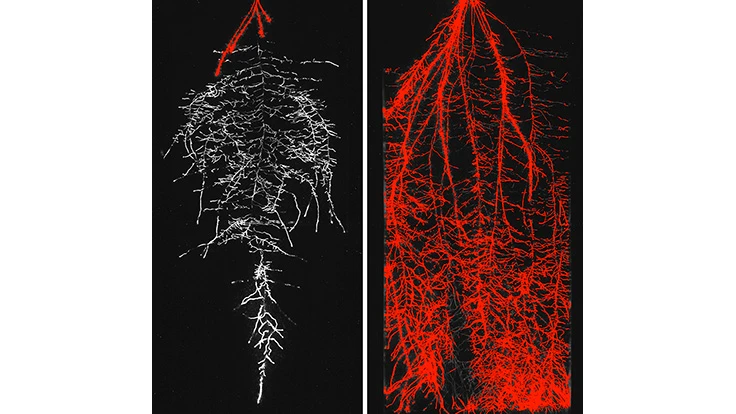
Photo: Roots systems of plants revealed using the GLO-Roots luminescence imaging system, which uses a firefly protein to visualize roots in soil. The root system on the left is from an early stage plant that is just beginning to initiate crown roots, whereas the plant on the right has a crown root system that is fully established. Crown roots are false colored in red. Image is courtesy of Jose Sebastian.
Latest from Nursery Management
- Meet the 2026 Leading Women of Horticulture
- [SNEAK PEEK] Leading Women of Horticulture: Louise Schaefer and Susan Tantsits
- The Growth Industry podcast Episode 10: State of the Horticulture Industry
- Tennessee Green Industry Field Day scheduled for June 11
- UTIA and UT Knoxville research teams will develop automated compost monitoring system
- Ken and Deena Altman receive American Floral Endowment Ambassador Award
- [SNEAK PEEK] Leading Women of Horticulture: Becky Thomas
- [WATCH] Taking root: The green industry’s guide to successful internships