Dave and Joyce Hart, owners of Hart’s Greenhouse & Florist LLC in
How it all started
The Harts started their greenhouse business in 1982 as an offshoot of their vegetable field production on 20 acres rented from the state.
“We were buying in all of our vegetable transplants and looking for ways to cut corners,” Dave said. He built a 4-by-15-foot cold frame made from windows he purchased from an old mill. He filled the cold frame with horse manure to generate heat. They produced 30-40 flats of tomato plants, which at the time seemed like a “huge” crop, he said.
The Harts had 10 tomato flats that they didn’t plant so they sold them to a hardware store.
“The store bought them for $3 a flat,” Dave said. “We made $30. We thought we were rich having made that much money on a few tomato plants we grew in a cold frame. Based on that sale, we decided to expand.”
Dave and Joyce built a 15-by-20-foot greenhouse on top of an old chicken coop foundation and heated it with an old barrel wood stove. The next year, the Harts sold $300 worth of transplants to the same hardware store.
In 1983, after expanding the size of the greenhouse, the Harts added flowering plants to their product mix. That same year they also expanded their family with the addition of their twins Christopher and Jessica.
The first indication that flower sales could prove to be a lucrative business for the Harts came around Memorial Day. They had posted a sign in their front yard indicating they had flowers for sale.
“I remember coming home and seeing our yard full of cars,” Dave said. “I thought that something bad had happened. Joyce told me people were bringing her big pots and they wanted her to fill them with plants for them to take to the cemetery. That was the start of our Memorial Day mixed container gardens. We were actually ahead of our time.”
From that point on, the Harts began to focus on flower sales.
The first move
The Harts moved to their current
The Harts said they experienced some hard times from 1988-1990. One of their major problems was obtaining financing.
“Everything we did was with Farmers Home,” Dave said. “We bought our home and first equipment through Farmers Home. This government program rarely had money available for farmers except for home financing. Occasionally they’d call us up and tell us there was $3,000 available if we wanted it to build a greenhouse. We’d take it, but we couldn’t do much with $3,000. They didn’t have a program for operating money, and that is what we needed.”
Because the Harts didn’t have a lot of equity, most lenders didn’t want to deal with them. In 1991, the Harts received a $15,000 line of credit from Farm Credit that was guaranteed through Farmers Home.
The Harts bought $15,000 worth of plant material for their greenhouses, sold it and paid back the debt. “When we finally got a lending institution that would support us and believe in us, that’s when our business really took off,” Dave said. “Farm Credit is now our partner. It really does take money to make money.”
Money talks
Once the Harts were able to get financing, they achieved a feeling of comfort.
“We were able to buy more product so we could offer a more diverse line of plants as well as fancier containers,” Dave said.
The Harts also added more greenhouses for production and retail.
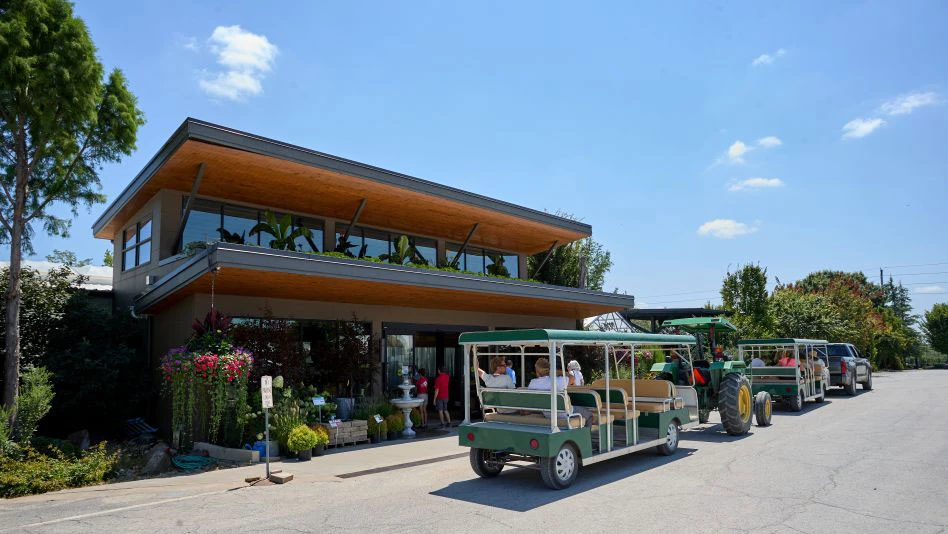
“We were big into concrete walkways and covered shopping,” Dave said. “We didn’t want our customers having to drag their carts through mud.”
The Harts purchased a second retail location in
“That was another huge turning point for us,” Dave said. “We basically doubled our income overnight.”
“Once we opened the
Need for more greenhouse space
With the addition of the second garden center, the Harts maxed out the 30,000 square feet of greenhouse production space at their
“At about this time we started getting more interested in mechanization,” Dave said. “In the early ’90s two of the world’s largest casinos opened within 20 minutes of us. They gobbled up all of the labor. There are so many of the local people who work there that we just couldn’t compete. We pay about the same wage, $10-$12 an hour. But they offer good benefits and the jobs are less labor intensive and the buildings are air-conditioned.”
The first piece of equipment the Harts purchased was a Gleason flat filler. Ever since, the Harts have been looking for ways to make work easier and more efficient.
“That (flat filler) cost us $7,000. We had people who worked for us who thought we were crazy,” Dave said. “They asked why would we spend that kind of money when they could do the same job by hand. The payback for that flat filler was easily during the first year.”
Four years later the Harts added a Rapid Transplanter.
“Our very best [human] transplanter could hand-transplant 14 1020 flats in an hour on a good day,” Dave said. “Again, our workers gave us flack when we spent $24,000 for the transplanter, which we saw at a trade show. The transplanter enabled us to do 200 flats an hour.”
One lesson that Dave quickly learned with the transplanter was the need to have a full plug flat for the transplanter to be most effective.
“When we transplanted manually, germination rate was not a big concern because the seedlings were transplanted by hand,” Dave said. “But you need 100-percent germination when transplanting plugs. We bought in some plug trays and ran them through the transplanter. It was like magic. Now we pay a little more for full trays, and it’s well worth it.”
The Harts have added a Visser PC-9 transplanter, which is more versatile and can transplant any size plug tray and vegetative cuttings.
“With the Visser transplanter, which we saw at the NTV show in
The Harts have gone back to
“The only piece of equipment we don’t use that often is the tagger,” Dave said. “We don’t run thousands of flats of say, Super Elfin Red impatiens, at one time. We might do 200 flats and then have to change the tag. It’s just easier to do it by hand.”
Adding production space
After purchasing their second
“The state only had $500,000 and was giving away about 12 grants, up to $40,000,” Dave said. “We wrote this long, detailed business plan and stood in line for 2 1/2 days to submit our proposal.”
“We figured we could build the greenhouse for about $80,000, but it actually took $100,000,” Joyce said.
One thing that Dave wanted in this new greenhouse was some type of bottom heat.
“We had become more experienced growing plants and knew what we needed to do,” he said. “We had had a lot of problems growing
Once Dave and Joyce decided on heated flood floors they contacted Trueleaf Technologies.
“Initially, Jim Rearden at Trueleaf was a little apprehensive about working with us because of our size. He was concerned that the cost per square foot would be too high for us,” Dave said. “It wasn’t cheap. It cost us nearly $300,000 for the heat and the floor. Just like the flat filler and transplanters, the bottom heat and flood floors were well worth the cost. It was truly the best thing that we have ever done.”
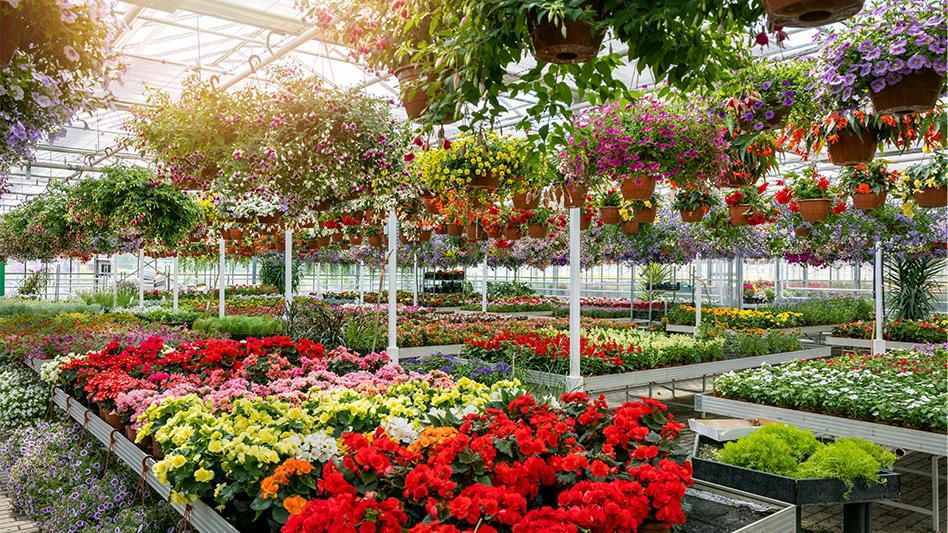
After the floors were installed, the Harts saw dramatic improvement in the growth of geranium,
“There’s no Botrytis. There’s very little fungus gnat problems because the top of the growing medium remains dry,” Dave said.
“Every single plant looks good,” Joyce said. “The plants all look the same and there are very few losses.”
Sold on retail
After adding the greenhouse space, the Harts looked for ways to keep the facility full as much as possible.
“We started a prefinished program through a broker producing some 10-inch baskets and 4-inch material,” Dave said. “We did that for three years, but stopped after 2005 because we weren’t making money and because it interfered with our own retail business. We weren’t set up to ship having only 80 carts. That last week (around April 1) we were trying to ship out orders as well as trying to do our own transplanting, plant up mixed containers and our retail stores were starting to open.
“We’re retail growers. Even though the wholesale business was growing for us, there just wasn’t any profit for us. We’re used to dealing with dollars rather than pennies. It’s hard for us to wholesale a 10-inch hanging basket for $9 when we know that we can get $24.99 for it retail.”
The Harts opened their third retail store in
The Harts feel that they timed the opening of the
“The town of
For more: Hart’s Greenhouse & Florist LLC, Route 14, P.O. Box Canterbury, CT 06331; (860) 546-6541; fax (860) 546-2069; daveandjoyce@hartsgreenhouseflorist.com; www.hartsgreenhouseflorist.com.
Hart’s Greenhouse & Florist LLC
Founded: April 1982 by Dave and Joyce Hart.
Locations: Two greenhouse production facilities in
Size:
Crops: Annual bedding plants, perennials, flowering potted plants, vegetables, herbs and rose bushes.
Customer base: Retail through their own garden centers to a customer base from
Employees: 20 full time, 40 seasonal.
Second generation prepares Hart’s for future growth
Dave and Joyce Hart are proud that their children Chris and Jessica have decided to join them in their business, Hart’s Greenhouse & Florist.
“If it wasn’t for our kids, we would have eventually been looking to sell the business, Dave said. “Joyce and I would have probably run the business for another 10 years and then we’d have cashed out. They are so interested in the business and that’s why we went ahead and added the
Chris and Jessica want to keep the business growing, and that includes eventually consolidating production to one of two
“We would prefer to grow everything ourselves, but it’s not like we have to have the additional greenhouse space,” Dave said. “We know enough growers in the Northeast that we could buy plant material and keep our stores full. We’ll see how the economy goes and how the business grows for us. We have to know that the market is there that our retail can support our current production.”
Marketing poses challenges
Joyce and Dave Hart, owners of Hart’s Greenhouse & Florist LLC in
This year, Hart’s will produce plants in 4 1/2- and 6-inch and 1-gallon branded Poppelmann pots.
“We think it is important to get our name out there along with our brand more so than someone else’s,” Dave said. “We will use our logo on everything but the Proven Winners plants. We do use the PW pots”.
{sidebar id=1}
- David Kuack
Latest from Nursery Management
- [SNEAK PEEK] Leading Women of Horticulture: Becky Thomas
- [SNEAK PEEK] Leading Women of Horticulture: Angela Burke
- [SNEAK PEEK] Leading Women of Horticulture: Alexa Patti
- Get to know Hailey Clark
- Get to know Brian Kemble
- Proven Winners partners with Pure Line Seeds to offer vegetable plants
- [WATCH] Taking root: The green industry’s guide to successful internships
- Award winners announced for 2026 PHS Philadelphia Flower Show