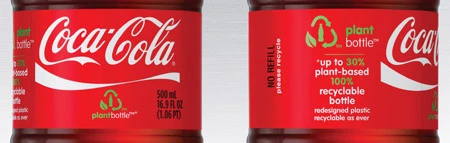
Coca-Cola Co. has announced that beverages in its PlantBottle packaging are beginning to arrive on store shelves in select markets throughout the world. The goal of the company is to produce 2 billion of the special PET plastic bottles by the end of 2010. PlantBottles are made partially from plants, reducing the company's dependence on petroleum. Another benefit is that the bottle is 100% recyclable. Preliminary research indicates that from the growing of the plant materials through to the production of the resin, the carbon footprint for the PlantBottle is smaller than for bottles made with traditional PET.
Throughout Denmark, Coca-Cola, Coca-Cola Light and Coca-Cola Zero in 500 ml and 2 L sizes are now available in the PlantBottle packaging. A variety of products, including Coca-Cola, Sprite, Fresca and Dasani will be in Western Canada in the PlantBottle beginning in December and for the Vancouver 2010 Winter Olympic Games. For select markets in the western U.S., including Seattle, San Francisco and Los Angeles, the packaging will be used for sparkling brands and Dasani in several sizes, starting in January. Future launches are being planned in other markets, including Brazil, Japan and Mexico and for China's Shanghai Expo in 2010.
PlantBottle packaging is made through a process that turns sugar cane and molasses into a key component for PET plastic. Ultimately, the company's goal is to use non-food, plant-based waste, such as wood chips or wheat stalks, to produce recyclable PET plastic bottles.
While the bio-based component can account for up to 30% of the resulting plastic in the PlantBottle, the percentage varies for bottles that also contain recycled PET. Denmark uses recycled content in its PlantBottles. The combined plant-based and recycled content makes up 65% of the material, with 50% coming from recycled material and 15% from plant-based material. For PlantBottles in the U.S. and Canada, up to 30% of the content in the PET plastic comes from plants.
Scott Vitters, Coca-Cola’s director of sustainable packaging, said the goal is to “continue innovating to achieve a bottle that is made with 100% plant-waste material while remaining completely recyclable.”
Latest from Nursery Management
- Jackson & Perkins expands into Canadian market
- Green & Growin’ 26 brings together North Carolina’s green industry for education, connection and growth
- Marion Ag Service announces return of Doug Grott as chief operating officer
- The Garden Conservancy hosting Open Days 2026
- Registration open for 2026 Perennial Plant Association National Symposium
- Artificial intelligence applications and challenges
- Fred C. Gloeckner Foundation Research Fund calls for 2026 research proposals
- Harrell’s expands horticulture team with addition of Chad Keel