Image Credit: Clemson University
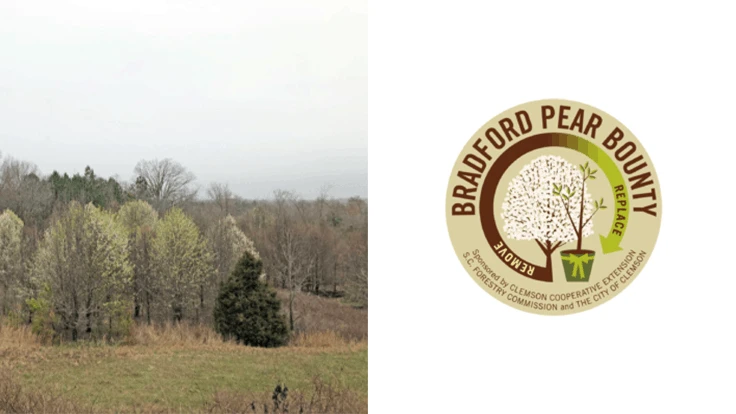
The Clemson Cooperative Extension is partnering with the City of Clemson and the S.C. Forestry Commission on the Bradford Pear Bounty program, which gives homeowners the option to remove Bradford pears and replace them with native trees.
Clemson area property owners are encouraged to exchange up to five Bradford pear trees for an equal number of free, healthy, native, young replacement trees.
The event is set for 9 a.m. to 1 p.m., Feb. 29, at the large picnic shelter at Nettles Park, 102 Nettles Park Road, Clemson, SC 29631. Registration and tree reservation are required. Please see the Bradford Pear Bounty website for full details and a link to register for the event.
Bradford pear trees have become ubiquitous in the southeastern U.S. thanks to their attractive white blossoms in the spring and bright red foliage in the fall, but experts from Clemson University and elsewhere say their negative impacts on the landscape far outweigh any cosmetic benefits.
While this tree species — Pyrus calleryana — has been widely planted in the Upstate for years, most commonly as the Bradford pear cultivar, it is not native to the United States and thus functions as an invasive species — meaning they are not naturally present, create economic and ecological damage, and displace native species.
Latest from Nursery Management
- The Growth Industry Episode 10: State of the Horticulture Industry
- Tennessee Green Industry Field Day scheduled for June 11
- UTIA and UT Knoxville research teams will develop automated compost monitoring system
- Ken and Deena Altman receive American Floral Endowment Ambassador Award
- [SNEAK PEEK] Leading Women of Horticulture: Becky Thomas
- [SNEAK PEEK] Leading Women of Horticulture: Angela Burke
- [SNEAK PEEK] Leading Women of Horticulture: Alexa Patti
- Native before it was cool