Photo © Adobe Stock
Editor's note: This is a new pest in Maryland, and new information is continually being discovered. For updated information, visit the University of Maryland Extension website.
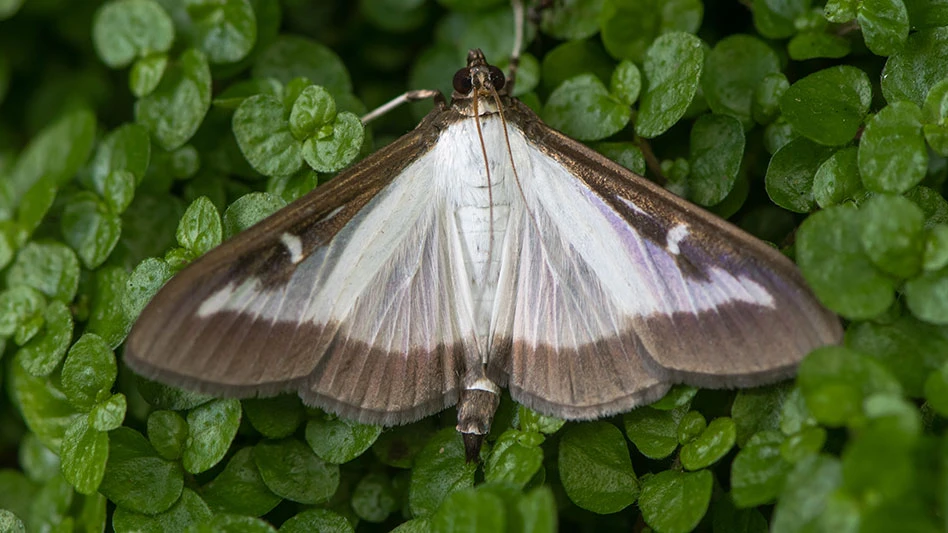
The first confirmed report of box tree moth in Maryland was in Washington County in July 2025.
This insect pest overwinters as larvae that are about a half-inch in size. The larvae are within hard-to-find hibernaculum that have a sheer, water-resistant covering. Larvae feed from the inside area of the leaf to the outside edge, leaving the outer leaf rims on the plant.
When finished feeding on leaves, the caterpillars can also feed on the bark, causing branches to become brittle and dry.
The caterpillars will start to become active in March when temperatures are around 50 °F. The predictive model for 2026 shows the potential for some caterpillars to become active starting March 7; however, emergence will ramp up beginning March 21 after an accumulation of warmer days throughout the month.
Box tree moth larvae damage plants very quickly. If growers find overwintering hibernaculum or viable larvae in March, treat immediately with a residual insecticide. For spring treatment, the University of Maryland Extension recommends chlorantraniliprole (Acelepryn), as it has a long residual and is safe for pollinators.
Pruning and spring clean-up can help prevent the spread of box tree moth by preventing larvae from becoming adults. When small larvae are found during the growing season, Bacillus thuringiensis kurstaki (Btk) and B. thuringiensis aizawai (Bta) can be used. Be sure to get thorough coverage of the plant. Follow label directions closely to be sure you do not apply a control material that impacts pollinators when boxwood plants are in bloom.
The University of Maryland Extension is doing phenology work in Maryland this year to determine when each stage is active and how many generations box tree moth has in Maryland. Traps and pheromone lures can be purchased to help establish if box tree moth is present in your area and when adults are active. Place pheromone traps out starting in early May to monitor for first flight activity of adults.
Continue to monitor plants and traps if they're set out in the nursery or landscape. Another generation of larvae will be active starting in July and into October.
Based on 2025 tracking of this pest, Brian Kunkel from the University of Delaware reports that the number of actively feeding larvae decreased significantly in late September as the larvae created their hibernaculum.
Latest from Nursery Management
- Leading Women of Horticulture: Katie Elzer-Peters, The Garden of Words
- Leading Women of Horticulture: Amanda Thomsen, Aster Gardens
- Leading Women of Horticulture: Gladys Opiyo, Profile Growing Solutions
- Emerald Coast Growers celebrates 35 years in business
- Zach Galifianakis is hosting a Netflix show about gardening
- American Horticultural Society announces winners of 2026 Great American Gardeners Awards
- New Jersey governor signs Invasive Species Management Act into law
- Society of American Florists seeks nominations for floral industry awards; deadline April 1