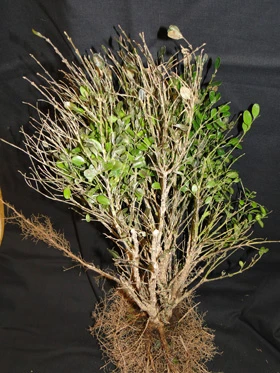
Connecticut plant regulators are recommending that those who receive shipment of boxwood plants this spring monitor them for boxwood blight.
Shipments should be isolated for about three weeks to observe the plants for any sign of the new fungus. Scientists lack a reliable test to determine if asymptomatic plants harbor the fungus. This puts all plant regulators – including those at the Connecticut Agricultural Experiment Station – in a tough position because of the risk in certifying a boxwood crop "clean" when in fact it may show infection later on, said the Connecticut Nursery & Landscape Association. Station inspectors will instead use the term "apparently free of disease."
The fungal spores can survive five years or more. CNLA has asked the Station to produce best-management guides for growers, retailers and landscapers. Station officials and CNLA agreed to a management plan for the disease that includes an every three-month system of rolling inspections at production nurseries. The Station is asking for good recordkeeping by all of propagation, spraying, and locating/selling the plants.
For a fact sheet on boxwood blight, go here: http://www.ct.gov/caes/lib/caes/documents/publications/fact_sheets/plant_pathology_and_ecology/boxwood_blight-_a_new_disease_for_connecticut_and_the_u.s.__12-08-11.pdf
Photo courtesy of the Connecticut Agricultural Experiment Station
Latest from Nursery Management
- Jackson & Perkins expands into Canadian market
- Green & Growin’ 26 brings together North Carolina’s green industry for education, connection and growth
- Marion Ag Service announces return of Doug Grott as chief operating officer
- The Garden Conservancy hosting Open Days 2026
- Registration open for 2026 Perennial Plant Association National Symposium
- Artificial intelligence applications and challenges
- Fred C. Gloeckner Foundation Research Fund calls for 2026 research proposals
- Harrell’s expands horticulture team with addition of Chad Keel