
Powdery mildew on rose. Photo: Iowa State University Plant Disease ClinicYou’ve probably seen the white, talcum-powder like growth on the upper leaf surface that heralds an infection of powdery mildew. However, many growers confuse downy mildew with powdery mildew. Both diseases can affect the same plant.
“Powdery mildews and downy mildews are completely different diseases,” said Jim Chatfield, associate professor and extension specialist, Ohio State University Extension, Department of Plant Pathology. “It’s unfortunate that they are worded so similarly, because they are very different in terms of disease cycles and what can help you control those diseases.”
The powdery mildew fungus is easily spread through the air and unlike many other foliar diseases, does not require wet conditions for infection to occur. Powdery mildews thrive when the temperature is cool and relative humidity is high. Severely infected leaves become brittle, wither, and die.
Many types of powdery mildew fungi have extremely narrow host ranges. This means that a powdery mildew that is affecting an azalea will not spread to a peony, powdery mildew on peony will not be found on ninebark, and the particular powdery mildew fungi that is on ninebark will not affect neighboring phlox.
“They have absolute specificity to what they can attack,” Chatfield said.
The fungi will not cross those very specific host ranges, except in a few rare instances. For example, consider a powdery mildew that occurs on sycamore (American planetree). The same fungus will infect London planetree as well. This is because London planetree is a cross between American planetree and oriental Planetree, so there is a lot of shared genetics between those two trees. The fungus can cross between them.
“Powdery mildew on lilac looks like it should cause powdery mildew on roses,” Chatfield said. “But it doesn’t. One thing we get ourselves into trouble with: powdery mildew is something you see on leaves and maybe fruits. We make such a big deal out of this and say if you see it on a stem, it can’t be powdery mildew. That is not true.”
.jpg) While most of the fungi that cause powdery mildew are very host specific, there are a few exceptions. As an example, Sphaerotheca violae only attacks viola. But Erysiphe, another fungi that causes powdery mildew, has a broad host range of over 300 different plants and attacks many members of the Aster family.
While most of the fungi that cause powdery mildew are very host specific, there are a few exceptions. As an example, Sphaerotheca violae only attacks viola. But Erysiphe, another fungi that causes powdery mildew, has a broad host range of over 300 different plants and attacks many members of the Aster family.
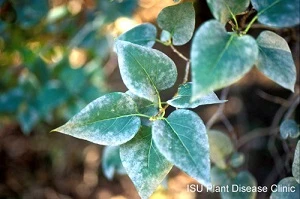
Powdery mildew on lilac. Photo: Iowa State University Plant Disease Clinic
University of Connecticut Extension Educator Leanne Pundt covered how to identify powdery mildew in the February 2014 issue of Greenhouse Management.
Pundt said that early infections often begin on the lowermost leaves. Sometimes, infected leaves turn purplish, resembling a nutrient deficiency. Growers should closely inspect the upper and lower surfaces of leaves for the white, powdery fungal growth on notorious powdery mildew hosts, such as gerbera daisies, beebalm, rosemary, and phlox to enable early detection.
Often mildew is a mid- to late-season problem, not becoming apparent until July or August. However, powdery mildew can occur any time throughout the growing season, according to Paul C. Pecknold’s “Powdery mildew of ornamentals.”
Pecknold urges growers to spray susceptible plants with an appropriate fungicide at the first sign of mildew. Cover the upper and lower surfaces of the leaves thoroughly. Repeat the treatment at intervals of 7 to 14 days or as often as necessary to protect the new growth.
Powdery mildew is most severe in heavily shaded areas. Avoid such locations when planting roses or other plants susceptible to mildew, i.e., lilac, zinnia, dahlias. Strive for good air circulation.
If powdery mildew is affecting one type of plant in your operation, another resource is “Powdery Mildew by Host Plant Cross-List” by Dr. Gary Moorman, Penn State University. This book is an excellent reference because so many types of mildew are very host specific and it can help you determine whether other plants in your operation could be affected.